|
UK Overseas Territories Conservation Forum Newsletter - 20032
By Lois Blumenthal
THREE PROBLEMS, ONE SOLUTION
The National Trust for the Cayman Islands has discovered that their bat house project does more than provide habitat for important, misunderstood native wildlife. It also pleases people who have been struggling with the problem of bats in their roofs, and reportedly keeps mosquitoes at bay.
“This has been a ‘win-win’ project from the very beginning,” comments Mrs. Lois Blumenthal, Director of the Bat Conservation Program there. “Our prison woodshop builds the bat houses and volunteers help us paint them and install them on donated utility poles. The generous contributions of these poles by Caribbean Utility Co Ltd (CUC) have been crucial to the success of the program. Utility poles are ideal for bat houses because they are strong enough to stand up to high winds and tall enough to be very attractive to the bats.”

Caribbean Utility Co Ltd (CUC) raising bat house mounted back to back on a utility pole.
The bat house project has gone hand in hand with a public education campaign involving all media. Lectures with a slide show have been presented to schools, condominium associations and service clubs. As work progressed, it became clear that Velvety Free-tailed Bats (Molossus molossus) living in roof spaces are a major problem for residents in the Cayman Islands. Tropical bats are active year round. Caribbean roof spaces are usually small and often inaccessible. This combined with high humidity creates a serious odour problem when large colonies inhabit a roof space. It is simply not practical or reasonable to attempt to convince citizens to live with this situation.
Previously, people dealt with bat problems by attempting to kill the bats, or by other misguided and ineffective means. The Trust has introduced the use of exclusion devices that effectively work as “one-way doors”. Bats can leave, but they can’t return again. Excluded bats often colonize new bat houses installed nearby. Sometimes a number of bats from a colony being excluded, are caught and “seeded” in a bat house, however, many bat houses that have not been “seeded” are also occupied within a few months after being erected.
People who have installed bat houses in their gardens report that they have fewer mosquitoes. It is thought that the echolocation sounds made by the bats may signal mosquitoes to avoid the immediate area, however a study is being carried out by the Cayman Islands’ Mosquito Research & Control Unit to see if the facts support this hypothesis.
It is known that bats play very important roles in healthy ecosystems, yet often even scientists overlook them. Caribbean bats pollinate hundreds of indigenous and endemic plants, they disburse seeds throughout forests, and are a major control of insect population – not only mosquitoes, but also moths and beetles and their larvae, many of which are crop pests. Some species eat cockroaches, katydids and other larger insects. Even fruit bats make 25% of their diet from insects found on and around fruit trees, thus helping to protect the very crops they also damage. Fruit bats eat overripe fruits missed by pickers and wild fruits that would otherwise rot and provide breeding grounds for fungus, fruit flies and other pests. In places where fruit bat populations have been eliminated, fruit losses actually increased, sometimes to the point where the farming of soft-skinned fruits had to be abandoned. Fruit bats are too large to use the bat houses, which are designed for insect-eating species. Separate initiatives are being taken to assist farmers to use environmentally sound methods to protect their soft-skinned fruits from fruit bats.
Vampire bats are not present in the Cayman Islands. On some Caribbean Islands, however, these tiny bats are considered to be a pest to domesticated animals. Of the nearly 1,000 species of bats, only three are known to feed on blood. Knowing the difference between vampire bats and other more beneficial species is very important when dealing with this problem. Mistakes can be disastrous. In some places, tragic eradications of insect-eating bats as well as fruit and nectar-eating species have disrupted entire ecosystems. Because bats reproduce so slowly, these mistakes cannot be reversed.
Bats are not rodents and are more closely related to monkeys than to mice. They produce only one pup per year and are known to live up to thirty years. Their low reproductive rate makes bats particularly vulnerable to extinction, especially those species that roost in large colonies.
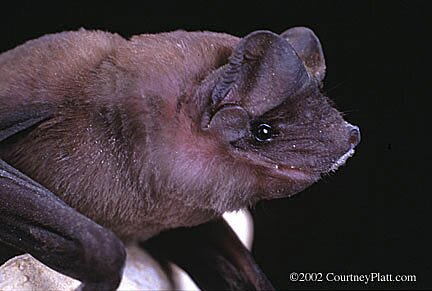
Smiling nicely for the camera, this Velvety Free-tailed Bat (Molossus molossus) seems pleased with the work being done to save his species.
The National Trust for the Cayman Islands has accumulated a large body of information on Caribbean bats and their conservation. They are very interested in sharing what they have learned with other islands that may have the same species and the same problems. The director of the program is willing to visit other islands to help launch bat conservation projects. Consideration is being given to the formation of a Caribbean Regional Bat Conservation Group, and perhaps a regional workshop could be held in the Cayman Islands.
A very comprehensive study guide about Cayman Islands bats has been published and could be adapted to other Caribbean islands. This study guide includes several appendices including copies of media coverage obtained for the program and information sheets distributed in schools as well as brochures addressing specific bat problems for the general public. It is available through the National Trust for the Cayman Islands.
Email the Bat Conservation Director at for copies of the materials developed for the public and more detailed descriptions of the various aspects of the program. Visit the National Trust for the Cayman Islands website at www.nationaltrust.org.ky for more about Cayman Islands’ bats and to see most of our brochures and information sheets.
|