| |
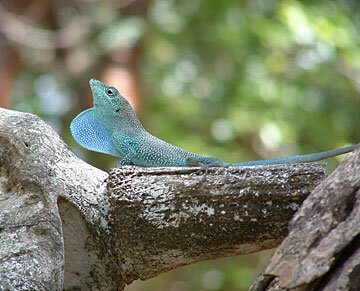
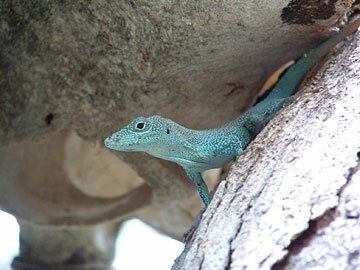
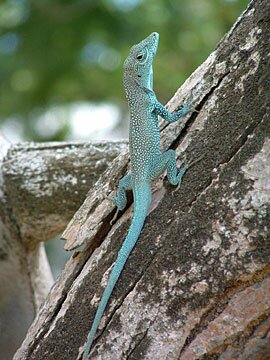
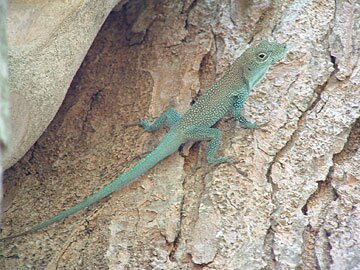
Size: Males can be up to 68 mm SVL, 205 mm TL females much smaller, up to 48 mm SVL, Colour & pattern: Males vary from bright turquoise to green, (particularly in the breeding season), however they also are able to change colour to dark brown, beige or pale gray, (hence their local name “chameleon”.) Patterning of the male on close inspection shows pale spotting over the entire animal. Males also have an erectable dorsal crest and a brilliant blue throat-fan. Female colouring ranges from pale gray to tan with a significant white line above the insertion of the foreleg. Females, on close inspection, will show dorsal chevron markings. Juveniles share common colouring and markings with females so that males will allow them within their territories. There can be further confusion since the females and juveniles of this species can resemble the females and juveniles of Anolis sagrei. With closer study, one can detect a difference in head profile since the conspersus has more prominent eye sockets and a somewhat concave area from eyes to nose. In addition there is a pale crescent immediately beneath the eye socket in the conspersus, lacking in the sagrei. These lizards are arboreal, but are often found on the sides of buildings. Tails can be lost and regenerated. Males tend to escape by retreating upwards, while females, juveniles and non-dominant males descend to the ground to hide. |