|
Bats are the only native mammals in the Cayman Islands. There are four species of snakes, various crabs, frogs, geckos & lizards, many beautiful birds and the amazing Blue Iguanas. Agoutis introduced from Central America live unobtrusively in our forests.
We will be adding more images and information about Cayman's native animals. There are thumbnail images below, please click on the thumbnail to see a better representation.
Sharing your Garden with Wildlife
Wildlife Rescue
Stories of Helping - Wonderful Volunteers and Fantastic Animals
Birds
Sea Turtles
Bats
Terrestrial Amphibians & Reptiles
Crabs
There are just over 50 species of butterflies on the three Cayman Islands. Please check the Butterflies and Moths page on our web site.
|
| |
|
Sharing your Garden with Wildlife
|
| A little tolerance and sharing is all that is needed for Cayman Islands wildlife to have a place in our gardens. As more and more land is cleared for development, people and animals can learn to share habitat, to the benefit of both! |
 |
SAVE THE CATERPILLARS!
Rule number one is „Don‚t kill the caterpillars!‰ You won‚t have butterflies if you do! A little leaf munching won‚t harm most plants and our butterflies are specifically adapted to eat only certain families of plants. A few caterpillars here and there in the garden do not mean an infestation! A little give and take goes a long way and as you learn to appreciate all our colorful butterflies, a chewed leaf will come to be a good sign and cause for pleasant anticipation of more butterflies!
WHAT IS A WEED?
Before you remove a weed ask, "What is this plant" and research it! Often you are pulling valuable "volunteer" plants that should be encouraged in your garden. Work with hand clippers, not weed-whackers and be selective when you pull "weeds."
NEW HOME CONSTRUCTION
If you are building a new home, DO NOT clear the land with a bulldozer. Try to retain as much native vegetation as possible during construction and work to enhance it gradually with a few colorful imported plants and selective culling.
WATER FOR LIFE!
Simple things like a birdbath can be a help to wildlife, especially during the dry season.
BAT HOUSES IN YOUR GARDEN
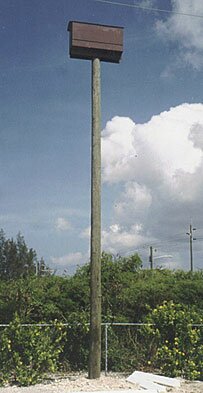 Install a bat house. For information and a free inspection of your property to find the best location, please CONTACT US. Install a bat house. For information and a free inspection of your property to find the best location, please CONTACT US.
REMEMBER THE BIRD NESTING SEASON WHEN YOU PRUNE
If you must prune or remove trees, check the branches for bird nests first. January and February are the only months when no species of Cayman Island birds are nesting. If the work cannot wait, the nests can be removed to another tree nearby. If the nest is too flimsy to move, it can be placed into an old basket and secured firmly in a tree. The Humane Society often has old baskets in their thrift shop. The parent birds will find it. Call the Wildlife Center for help if you need it.
PROTECT FLEDGLING BIRDS
If you find a bird on the ground, especially during April, May and June, it is probably a fledgling and does NOT need to be rescued. If there are no apparent injuries, leave it alone. Young birds must spend a few days fluttering on the ground while learning to fly. Their parents care for them during this process. Secure your dogs and cats during this time.
RESCUE INJURED WILDLIFE
If you find an injured bird or any other wildlife that needs veterinary care, please call . The Wildlife Center will cover the costs of veterinary treatment for wildlife and has volunteers to help with follow-up care.
PLANT THE TREES THAT BIRDS NEED MOST
Plant or retain trees that provide food or nesting spots for birds. Tamarind trees are naturalized, (but not native) and birds like to nest in their thick spiky branches. Chinaberry trees grow very fast, have lovely lilac-scented blooms and Cayman Islands Parrots love to eat the berries. Ficus or Fig trees are very important for birds and other wildlife because they fruit at random times year-round, providing a constant food source. (More complete list of "bird-friendly trees" to be posted here soon.)
PRACTICE TOLERANCE
Holes that crabs dig in the lawn can be annoying but some people think these brightly colored animals are as beautiful as the flowers! Use pavers on your pathways to avoid stepping in their holes and allow them to share your seaside home. Crabs will actually clean your lawn, removing dead insects, dog droppings and even capturing and eating cockroaches!
DON'T "OVER-GROOM" YOUR GARDEN
Allow some leaf litter to accumulate under your Sea Grape trees if you live along the coast. This is important habitat for Soldier Crabs (also called Hermit Crabs). These fascinating crabs also need to find shells to live in. With the over-harvesting of Whelks, tourists picking up shells on the beaches and fishermen breaking the shells to use the crabs for bait, there is a severe housing shortage! Soldier Crabs have been seen recently in coffee scoops, broken bottle necks and other debris because they can‚t find enough whelk shells on our beaches. If you have any of these black & white shells collecting dust in your home, toss them out onto a wild beach with plenty of leaf litter for the crabs to find!
LEARN THE LOCAL GEOLOGIC FEATURES
Learn about Cayman‚s Karst landscape and its fascinating formations ˆ retain them where possible, don‚t bury them. They provide protection for wildlife, storm surge protection for you, and allow rain to enter the ground water. Karst formations are a very dramatic feature in landscape design.
WE CAN'T ALL BE BEAUTIFUL!
FROGS: Frogs are completely harmless. Never kill frogs in your garden.
SNAKES: The Cayman Islands have no poisonous snakes. Our most common snake eats small animals and helps to control rodents. There is never any reason to kill a native snake in the Cayman Islands!
KEEP PETS UNDER CONTROL
Cayman Islands animals evolved with no major land predators and are not suited to defending themselves from dogs, cats or rats. These introduced hunters greatly impact Blue Iguanas, birds and other wildlife here.
DOGS
Keep your dog under control at all times, DO NOT allow it to roam freely. For the dog's safety as well as protecting wild animals. Roaming dogs destroy ground nests along our wetlands, eating eggs and killing young herons, egrets, stilts, coots and ducks.
CATS
Cats should never be allowed outside unsupervised. Even a well-fed cat enjoys a hunt and will kill significant numbers of island lizards and fledgling birds.
PET SHOP EXOTICS
Do not release imported pets like Green Iguanas, Red-eared Slider Turtles, Parakeets, Parrots or other non-native animals into the wild. These animals complete with our unique island species for food and habitat.
|
| |
|
| |
|
|
|
| |
|
Wildlife Rescue
|
|
|
|
|
| |
Every single tree
and patch of ground it roots in;
Every pond and wetland;
Every forest and beach;
Every rocky cliff, cave and crevice
is 'home' to a wild animal.
When you look in the eyes
of these displaced, sick
and orphaned animals
you understand and you see
that they are
the helpless victims
of habitat loss.
What is our personal responsibility?
To mitigate the damage we have done.
courtesy of Niagara Wildlife Haven
|
| |
|
| |
|
|
To visit the Cayman Wildlife Rescue website, click < here >
|
|
| |
| If you find an injured or at-risk wild animal call: |
|
Wildlife Rescue Center Hot Line. |
| |
As civilization envelopes more and more of our islands, the human-wildlife interaction will only increase – always to the detriment of the animals. While humans complain about droppings on their verandas or one-inch diameter holes in their lawns, or too much noise at dawn – the animals are losing their homes, food sources and all means of survival. We hope to use our unique position in the forefront of the human/animal interaction zone to teach tolerance and understanding and that solutions can be found that do not involve the death of the animals. |
|
| |
|
| |
- top of page -
|
|
Stories of Helping - Wonderful Volunteers and Fantastic Animal. The opportunity to work with wildlife is an incredible privilege. Here are just a few of the many stories.
|
| |
|
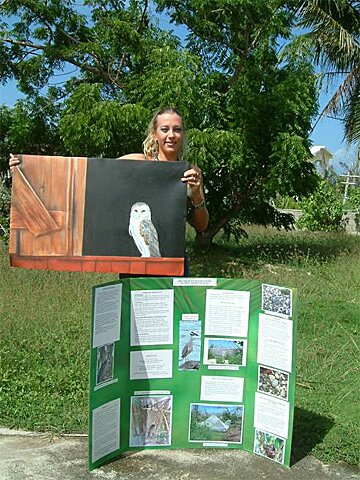
Tansy Maki displaying a poster she made to take to the International Wildlife Rehabilitation Council Workshop. The painting of the owl was donated to their fund-raising auction. We are in close touch with organizations like this, and rely on them to assist with protocols (like the threat of Bird Flu) and for both general and specific advice as our fledgling organization grows.
Photo by Lois Blumenthal
|
|
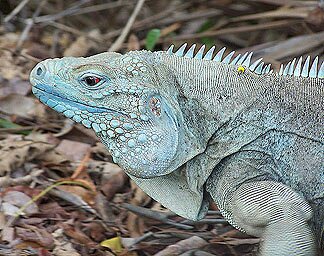
The Blue Iguana Recovery Program is a separate, but often overlapping endeavor. To learn more about BIRP and to find out how to volunteer to help, visit www.blueiguana.ky or www.nationaltrust.org.ky
Photo by David Blumenthal
|
|
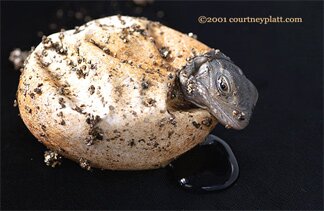
Improved nutrition was the key to successful captive breeding. Photo by Courtney Platt
|
|
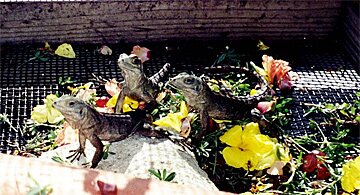
Baby Blue Iguanas eat flowers, so their cage is always beautiful! For more on this very successful National Trust Program visit www.blueiguana.ky or www.nationaltrust.org.ky
Photo by Lois Blumenthal
|
|
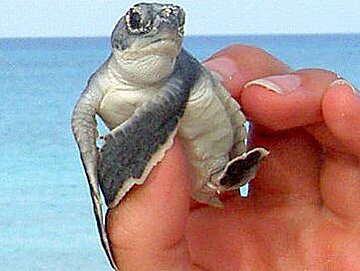
The Cayman Islands Department of Environment monitors the wild sea turtle populations. Volunteers walk Cayman Islands beaches during the summer months so they can protect sea turtle nests and hatchlings. To volunteer contact the Cayman Islands Department of Environment Sea Turtle Project.
Photo by Janice Blumenthal
|
|
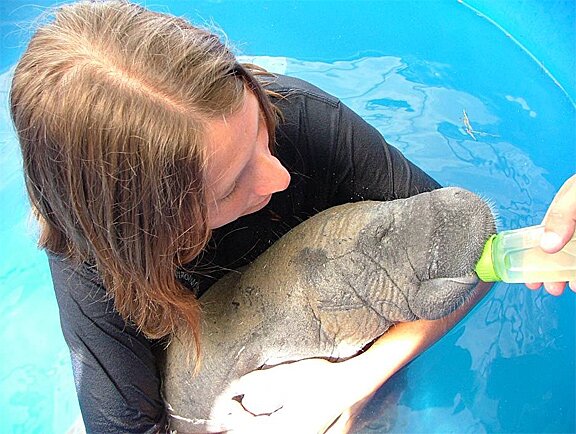
A rare event. This newborn manatee was found floating alone near Grand Cayman. The Cayman Islands Department of Environment and volunteers fed and cared for this baby –named 4B after the four men who found him (all with names starting with the letter “B”.) He was air-lifted to the Lowry Park Zoo in Tampa, Florida where he is growing and thriving.
Photo by Lois Blumenthal
|
|
| |
|
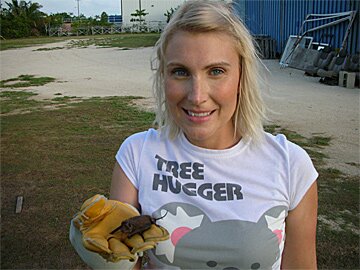
This Velvety Free-Tailed Bat was rescued after being trapped inside a bathroom, after being treated for dehydration it was then released later that evening. If you find bats inside your home or in your roof please contact to arrange a bat exclusion.
|
|
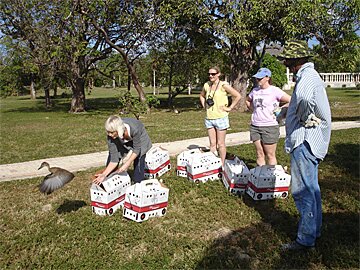
Several rehabbed West Indian Whistling Ducks Found a new and safe home on the property of Handel Whittaker. This species was almost extirpated in the Cayman Islands due to hunting and Hurricane Ivan. They are now thriving in Cayman as many people are feeding them and a ban on hunting is enforced. Cayman Wildlife Rescue stresses the importance of never feeding wildlife roadside or in high traffic areas.
|
|
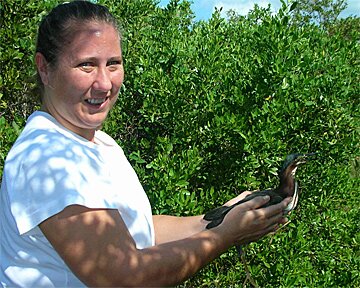
This Green Heron was rehabbed by CWR volunteer Virginia Gibbs, after a lengthy time on rehab it was finally ready for release.
|
|
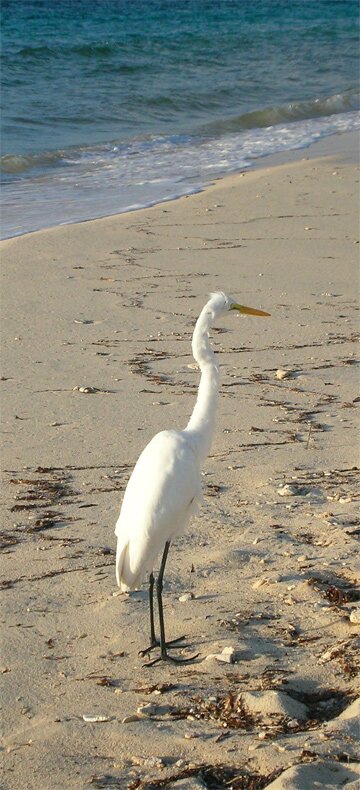
Great Egrets are winter migrants and unfortunately fall victim to the increased island traffic. This Egret was rescued roadside and after fluid therapy and regaining its strength a release was possible after only a few short days in care.
|
|

Cats are deadly to wildlife, luckily this Ground Dove managed to survive a cat attack. However due to his injuries "Peeps" was not releasable. He was placed at Boatswains Beach in their spacious aviary and is doing very well and fathered young recently.
|
|

This young Agouti, also known as a Cayman Rabbit, was found with some trauma and after a course of antibiotics and care it was released. Agoutis are not native to the Cayman Islands, but have been here for quite a long time and are regarded as having minimal impact on native wildlife.
|
|
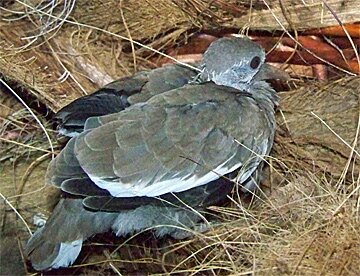
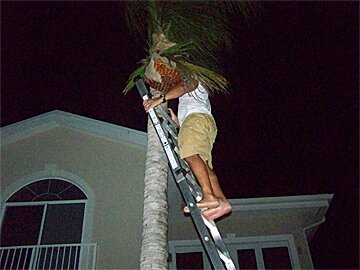
Often when people trim their trees, nests are brought down. Nests and nestlings can be restored to the tree. In this case, the nest was badly damaged and a new nest was constructed using a basket. For more information please see our Helping Baby Birds page. Remember: Birds have little sense of smell, so there is no truth that handling the young will cause abandonment. Birds are in fact wonderful parents, these parents returned after being separated from their young for 36 hours.
|
| |
|
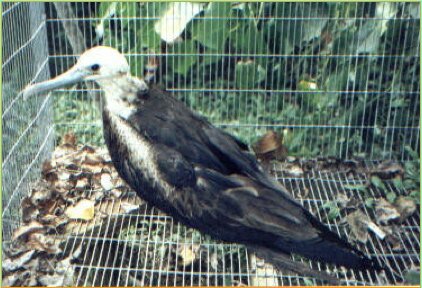
MAGNIFICANT FRIGATE BIRD – Fregata magnificens – also called “Man o’ War” – This bird fell from the night sky into a back yard full of dogs. The owner rescued the bird which appeared to be uninjured. Possibly the colony was disturbed while roosting and flew upwards in panic. Two birds might have collided causing this one to lose balance and fall.
Photo by Joanne Ross
|
|

Suncoast Seabird Sanctuary (www.seabirdsanctuary.org) in Tampa Bay, Florida advised that Frigate Birds did not survive well in captivity and that since no injuries were apparent we should attempt a release ASAP from a high beach ridge where recapture would be possible if the bird could not fly. Top volunteer, Joanne Ross handled the release.
Photo by David Blumenthal
|
|
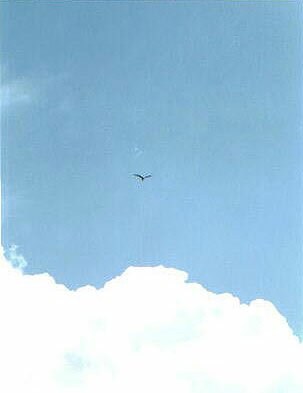
Success! – Frieda soared away to cheers and applause. Photo by David Blumenthal
|
|
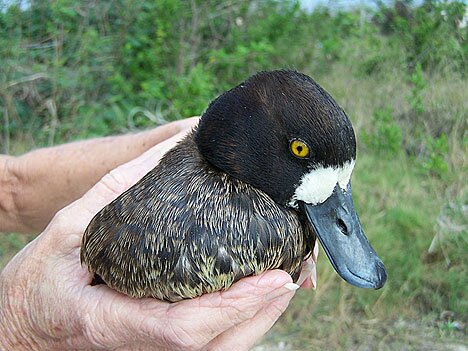
LESSER SCAUP Aythya affinis – brought to veterinarian’s office by a member of the public. No apparent injuries.
Photo by Lois Blumenthal caymanwildlife.org
|
|
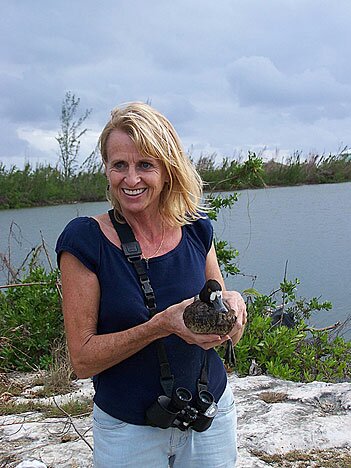
Local bird enthusiast and co-founder of the Cayman Islands Bird Club, Ms. Mars VanLiefde was consulted. She pointed out that Scaups were divers and needed a pond at least six feet deep. Most Cayman Islands freshwater ponds are quite shallow but she remembered one on a back road near Spotts.
Photo by Lois Blumenthal caymanwildlife.org
|
|
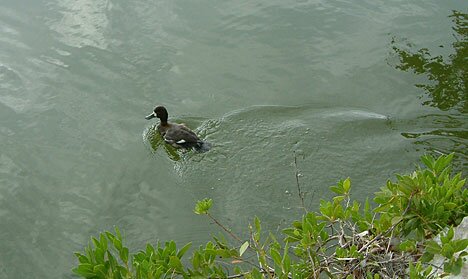
Successful Release! Photo by Lois Blumenthal caymanwildlife.org
|
|
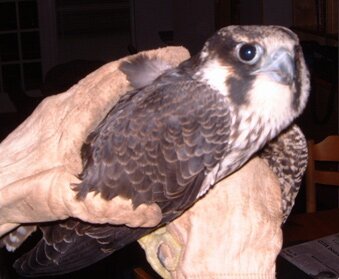
PEREGRINE FALCON Falco peregrinus – Found under electrical wires on Seven Mile Beach with broken wing. While diving for prey at extremely high speeds these birds will sometimes hit wires, causing severe injuries. Photo by Courtney Platt www.courtneyplatt.com
|
|
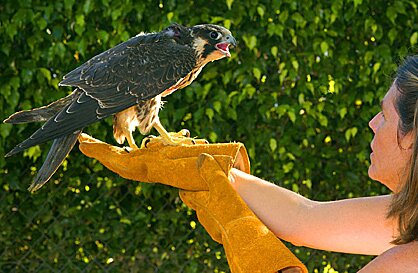
These birds can be very dangerous, but volunteer extraordinaire, Joanne Ross was able to capture it without incident.
Photo by Courtney Platt www.courtneyplatt.com
|
|
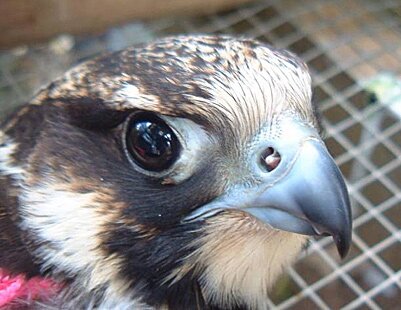
After failed attempts to set the wing, and with the sad realization that this bird would never fly again and would face a frightened lonely life in a cage it was reluctantly euthanized. The Cayman Islands have no dedicated facility for the permanent captivity of large birds in a natural setting. Transfer to bird sanctuaries in other countries is extremely problematic due to international regulations and attempts to pursue that option failed. It’s mate was seen flying in the area for many weeks but eventually continued its migration alone.
Photo by Courtney Platt www.courtneyplatt.com
|
|
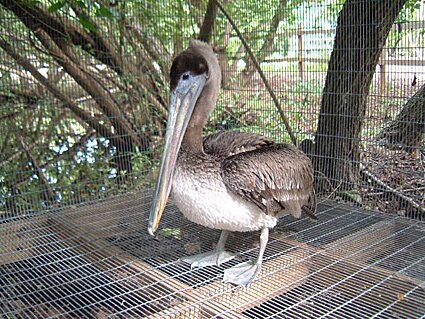
BROWN PELICAN Pelecanus occidentalis – These large seabirds are often in rehab in Cayman for various injuries. Sometimes hooks are caught in the beaks, some have been deliberately assaulted by fishermen for “stealing” while fish are being cleaned in GeorgeTown, some are weak and lice-infested or have infections. All respond very well to treatment and so far they have all been successfully released back to the wild. They do not breed here but appear usually in the winter months as young adults, recently “pushed out” by their mothers on other islands.
Photo by Teresa Strad
|
|

GeorgeTown, Grand Cayman fishermen watch as Lois Blumenthal releases a Brown Pelican that recovered from a head injury. These fishermen enjoy pelicans and often feed them scraps of fish, but there can be problems when the birds become too comfortable around people. Not all fishermen have such a friendly attitude. There have also been problems when the pelicans are fed sharp fish bones, unprotected by the flesh of the fish.
Photo by Satu Troyer
|
|
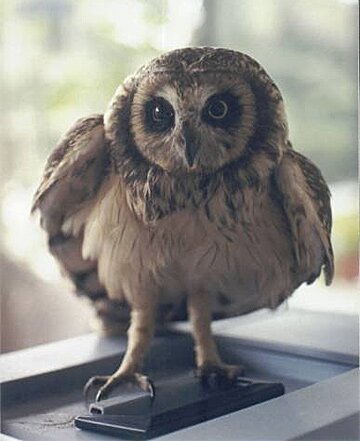
Short-eared Owl Asio flammeus - Photo by Joanne Ross
|
|
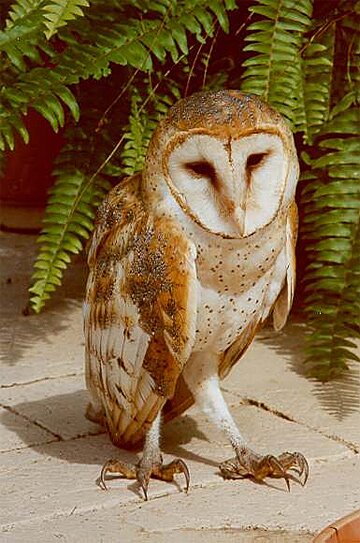
BARN OWL Tyto alba also called Screech owl – Very wobbly and sick – possibly poisoned from eating rats & mice with rodenticide in their systems. This owl died.
Photo by Maggie Ward
|
|
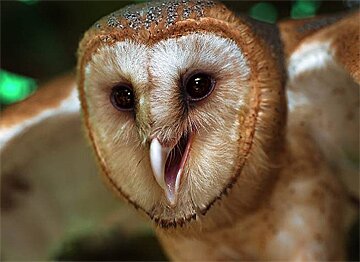
Another Barn Owl Tyto alba – This one was rescued when it fell from an inadequately secure nest after two siblings had fallen and died. It was fed rats caught in live traps and eventually released.
Photo by Courtney Platt www.courtneyplatt.com
|
|
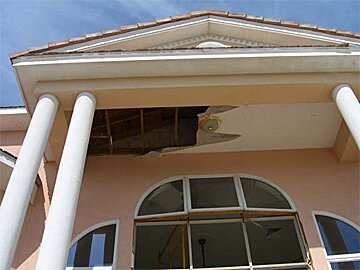
Hurricane Ivan severely damaged homes in Cayman and destroyed wildlife habitat as well. Barn Owls find nesting roosts in places like this.
Photo by Lois Blumenthal caymanwildlife.org
|
|
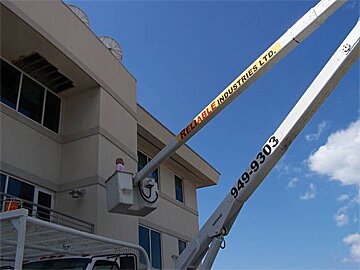
Barn Owls also nested in this bank. Here, Patricia Bradley is lifted up to check the growth of the chicks. When they fledged, the owls were chased away and building repaired.
Photo by Lois Blumenthal caymanwildlife.org
|
|
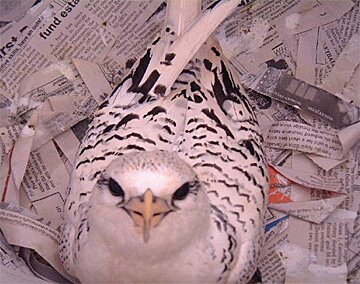
White-tailed Tropic Bird Phaethon lepturus – also called Boatswain bird. – It was rescued by a member of the public and brought to us after it fell from nest on the Bluff on Cayman Brac.
Photo by Joanne Ross
|
|
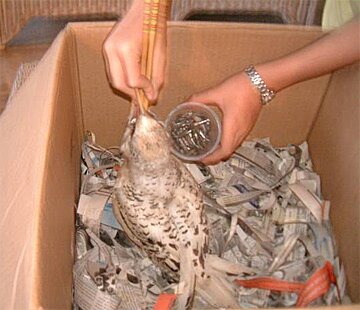
Tropic Bird being fed small fish with chopsticks which more closely resemble a mother Tropic Bird beak than do human fingers.
Photo by Joanne Ross
|
|
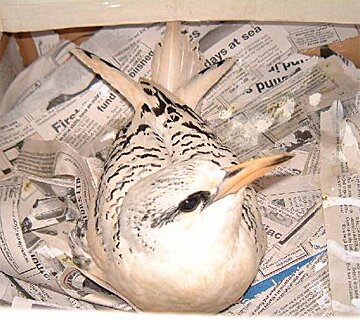
Also called Boatswain bird, this Tropic Bird escaped on Grand Cayman just before it could be returned to the Brac for release. We hope it found its way to the rest of the colony. Now, orphaned and injured birds on Cayman Brac are cared for by local artist "Foots".
Photo by Joanne Ross.
|
|
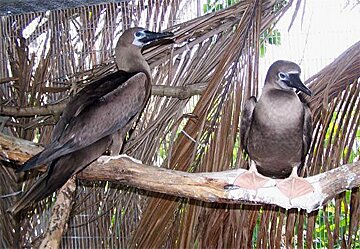
Red-footed Boobies Sula sula From Little Cayman. Photo by Lois Blumenthal caymanwildlife.org
|
|
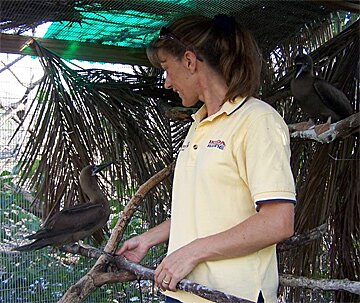
Lovingly cared for by volunteer Theresa Strad. Photo by Lois Blumenthal caymanwildlife.org
|
|
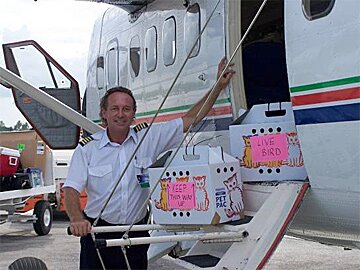
Red-footed Boobies Sula sula Heading home to Little Cayman. One did well and was successfully released back into the colony, the other had more damage to it’s wing, could not regain the coordination to fly and had to be euthanized.
Photo by Lois Blumenthal caymanwildlife.org
|
|
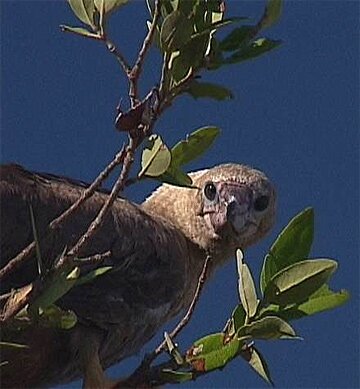
Red-footed Booby Sula sula in the wild on Little Cayman – While exploring the “bush” in Little Cayman looking for seeds for a native plant growing project, we accidentally found ourselves in the Booby nesting area. We were most unwelcome and left immediately – very sorry to have disturbed them.
Photo by Lois Blumenthal
|
|
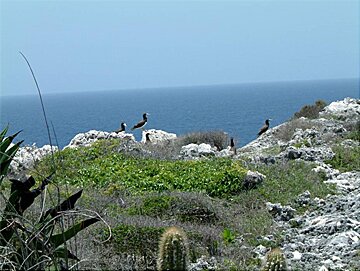
Brown Boobies Sula leucogaster colony on the bluffs of Cayman Brac – Photo by Tansy Maki
|
|
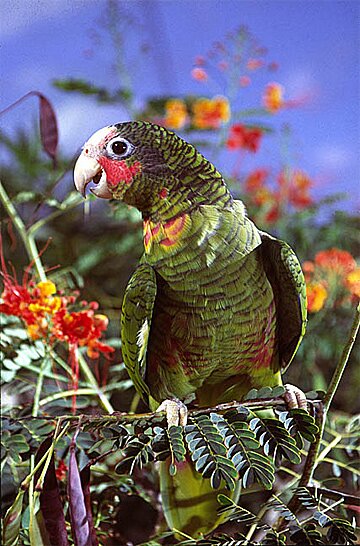
Cayman Parrots are frequently in need of help. They are hit by cars, have foot and leg injuries from attempted captures, and are turned in by owners who no longer want them. They are shot and killed by farmers. Chicks in the nests are poached – sometimes by cutting down the entire tree, thus destroying the nesting site forever. Hurricane Ivan and the deliberate shootings have reduced their numbers critically. They are being seen now in the western part of Grand Cayman, around suburban neighborhoods and away from the farms but there are few nesting sites in these areas. Cayman Wildlife Rescue coordinates an enhancement program for eight Cayman Parrots in an aviary in Savannah – which may be the beginning of a captive breeding program if this beautiful bird is not to go extinct. Hundreds of back gardens in the Cayman Islands have cages holding captive Cayman Parrots. Most of these parrots are alone and rarely even see people. Cayman Parrots are extremely sociable – in the wild they are always in couples and family groups. This isolated existence is torture for a parrot and Cayman Wildlife has published a booklet (downloadable on this site) to try to improve conditions for them.
Photo by Courtney Platt – www.courtneyplatt.com
|
|
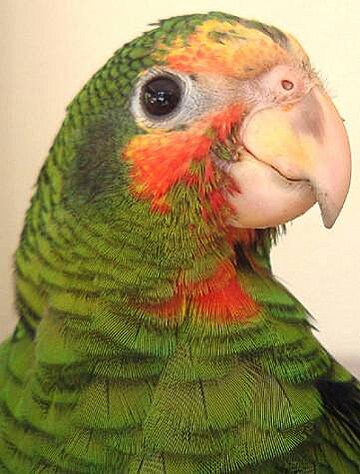
This parrot was found in the wild and thought to be a mixture of a Cayman Parrot and possibly the Cuban parrot of a close sub-species. As we do not release hybrids or non-native species into the wild, it was placed in a good home as a pet allowed to go to the US with its new owners.
Photo by Joanne Ross
|
|
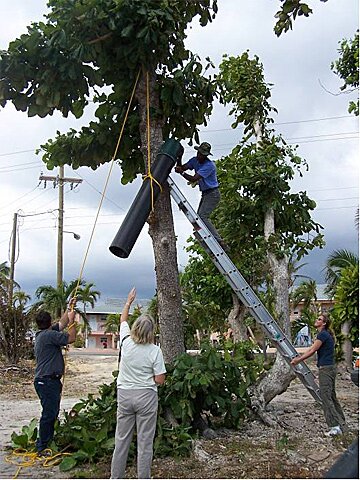
Putting up Department of Environment test models for parrot nesting boxes. Other models made of wood are being tested by CWR as well.
Photo by Lois Blumenthal
|
|

Baby bat pups that fell from a roof space onto a deck on Cayman Brac. Photo by Tansy Maki
|
|
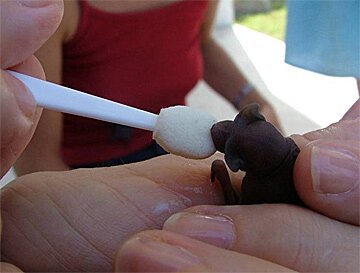
Bat pups were fed using eye-shadow sponges saturated with formula. – They were to be returned to the colony when they were old enough to fly, but were kept “as pets” until the family cat got them. This highlights the need for more and ever more education of the public. Wild animals belong in the wild – even if we think they are cute! Photo by Tansy Maki
|
|

Velvety Free-tailed Bat – Molossus molossus – being fed “glop”. These little bats live in roof spaces and bat houses and are frequently found by people when they are ill or injured. Most can be easily rehabbed and returned to the wild. They are insect-eating, so there “glop” must be very high protein.
|
|
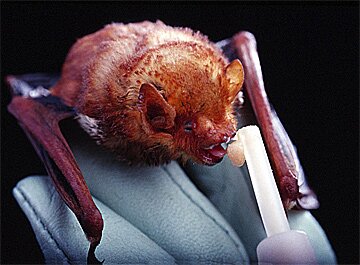
Another insectivore enjoys the “glop” – this Red Bat – Lasiurius ssp unknown was found on a wall at the prison. It was uninjured and only sleeping there. Because it had been in a prisoner’s hat for some indeterminate amount of time before we were called, it was fed before release that evening.
Photo by Anne Louise Band
|
|
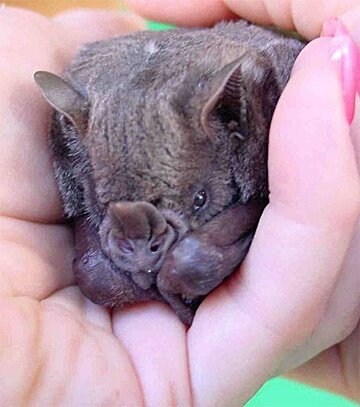
A fruit bat – It’s important to know what species an animal is before attempting to feed it. Each species has very special needs. We consult often with wildlife rescue experts around the world.
Photo from Denise Tomlinson
|
|
Thank you to the wildlife photographers who have donated their work. Annie Band, Denise Bodden, Lisa Bortolotto, David Blumenthal, Janice Blumenthal, Lois Blumenthal, Pedrin Lopez, Courtney Platt, Tansy Maki, Carla Reid, Sonny Rivers, Joanne Ross, Dorothea Schwab, Colin Sherrit, Ann Stafford, Teresa Strad, Tricia Sybersma, Denise Tomlinson, Satu Troyer, Maggie Ward, and Ross Wrangham. All copyrights remain with the photographers.
|
|
| |
|
| We support the National Trust in all its efforts to purchase and protect habitat and to ensure a future in the wild for Cayman Islands' native animals – furred, feathered, fanged, finned and even slimy! |
| |
|
| |
- top of page -
|
|
|
Birds
|
|
Visit the Cayman Biodiversity Virtual Bird Gallery
|
| |
|
| |
Patricia Bradley, ornithologist and author of Birds of the Cayman Islands has provided Cayman Wildlife Connection with this list of endemic Cayman Islands birds. (These birds are found nowhere else in the world.) Please visit www.naturecayman.com, your guide to the ecology of Cayman Brac and Little Cayman.
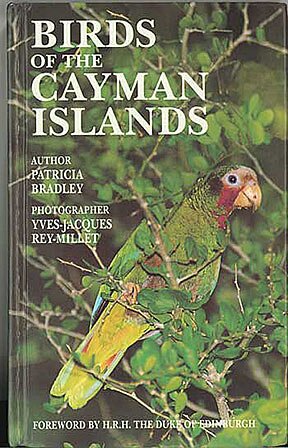
Look for the indispensable Birds of the Cayman Islands at bookstores and other venues throughout the islands.
|
The endemic races of landbirds found on Grand Cayman (GC), Little Cayman (LC) and Cayman Brac (CB)
|
| Grand Cayman Thrush |
Turdus ravidus |
recent on GC |
Extinct |
|
Caribbean Dove
|
Leptotila jamaicansis collaris |
GC |
|
|
Cayman Parrot
|
Amazona leucocephala caymanensis |
GC |
|
| hesterna |
CB |
|
|
W. Indian Woodpecker
|
Melanerpes superciliaris caymanensis |
GC |
|
|
Northern Flicker
|
Colaptes auratus gundlachi |
GC |
|
| Caribbean Elaenia |
Elaenia martinica caymanensis |
GC, LC, CB |
|
| Loggerhead Kingbird |
Tyrannus caudifasciatus caymanensis |
GC, CB |
|
|
Red-legged Thrush
|
Turdus plumbeus coryi |
CB |
|
| Thick-billed Vireo |
Vireo crassirostris alleni |
GC, CB |
|
| Yucatan Vireo |
Vireo magister caymanensis |
GC |
|
| Bananaquit |
Coereba flaveola sharpei |
GC, LC, CB |
|
| Vitelline Warbler |
Dendroica vitellina vitellina |
GC |
|
| crawfordi |
LC, CB |
|
| Western Spindalis (previously Stripe-headed Tanager) |
Spindalis zena salvini |
GC |
|
| Bullfinch |
Melopyrrha nigra taylori |
GC |
|
|
Greater Antillean Grackle
|
Quiscalus niger caymanensis |
GC |
|
| bangsi |
LC |
|
|
| |
|
| |
|
| |
Download the free booklet "Caring for Your Pet Parrot"
|
|
|
Download a free copy of our poster for schools about rescuing fledglings: "I'm Learning to Fly"
|
| |
|
| |
Helping Baby Birds
|
| |
|
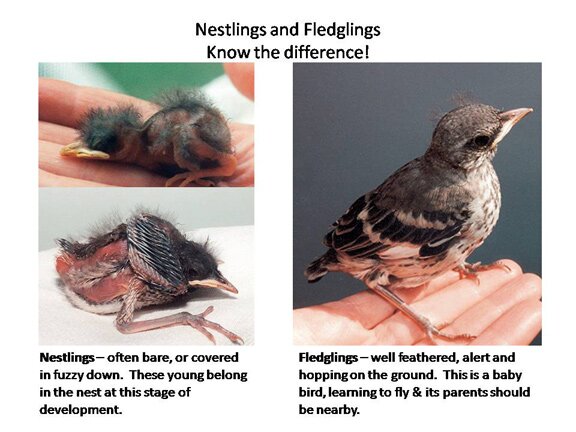
Don't be a birdnapper! Watch the bird first.
- Is the bird hurt? Call for free pick-up & veterinary care.
- If the bird is NOT hurt, but cannot fly, look to see if it's fuzzy or feathered.
- If the bird has feathers and is hopping on the ground it is a FLEDGLING. This is a baby bird learning to fly. The parents feed it on the ground.
- Is it in a safe place? If not, move it to shade, away from roads, cats & dogs.
Watch! If the parents do not come within 2 hrs, call
- If the bird is fuzzy it is a NESTLING. It belongs in a nest. Look around to see if you can find the nest. Put the bird back into the nest.
Watch! Parent Birds will return to care for it. If they don't – call.
- If there is no nest you can make one from a basket or plastic box. Put a few drainage holes in the bottom. Line it with pine needles, dried leaves and parts of the old nest if you have it. Firmly attach it to the tree where the nestling fell. Put the nestling in the new nest. Watch! for the baby bird's parents to return, if they do not come back in 2 hrs call.
DO NOT GIVE THE BABY BIRD FOOD OR FLUIDS.
NEVER ATTEMPT TO CARE FOR A WILD ANIMAL YOURSELF ALWAYS CALL.
DON'T TRIM TREES WITH NESTS IN THEM
KEEP DOGS AND CATS AWAY FROM BABY BIRDS Wildlife Rescue Hotline: www.caymanwildliferescue.org
|
|
| |
- top of page -
|
|
| |
|
|
Sea Turtles
|
| |
| Watch a video about sea turtle nesting season in the Cayman Islands |
|
| |
|
| |
Sea Turtles in the Cayman Islands
|
|
Grand Cayman (GC) Cayman Brac (CB) Little Cayman (LC)
|
|
Status |
Species also indigenous to: |
| Sea Turtles |
| Family Cheloniidae |
|
Loggerhead turtle
|
Caretta caretta |
GC, CB, LC |
Adult nesting |
Temperate, sub-tropical and tropical |
|
Green turtle
|
Chelonia mydas |
GC, CB, LC |
Adult nesting; juvenile foraging |
Sub-tropical and tropical |
|
Hawksbill turtle
|
Eretmochelys imbricata |
GC, CB, LC |
Adult nesting extirpated; juvenile foraging |
Sub-tropical and tropical |
|
| |
....go to Sea Turtles and Beach Vegetation page - click < here >
|
| |
|
| |
Read about our hero, Mark Orr, Acting Chief Enforcement Officer for the Cayman Islands Department of the Environment at www.observeronsunday.com - click on "Local" - then on "Turning the Tide Against Poachers"
To Report Poaching call Mark Orr directly .
|
| |
|
| |
Make your outdoor lighting Sea turtle-friendly. To learn more, type "Light Pollution" into a search engine or visit www.starrynightlights.com
|
| |
|
| |
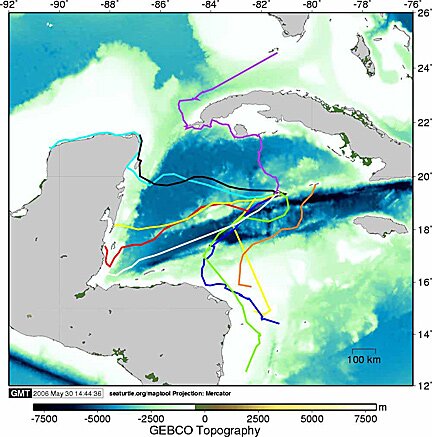
Cayman Island Turtle Tracking
|
| |
|
| |
|
| |
|
|
| |
|
Bats
|
|
|
| |
|
| |
Bats Study Guide for Teachers and Students
|
| Please click on the image to the right to download a copy of this Guide in Microsoft WORD. |
WARNING - BEFORE DOWNLOADING this file:
This was done on a PC in Microsoft WORD 2003 format. It is about 20Mb and could take a substantial amount of time to download. If you use other software or platforms the download may not be successful and/or formatting could be different. |
|
|
|
Permission is granted to copy and adapt materials for conservation-related educational purposes with credit given to Cayman Wildlife Connection and the National Trust for the Cayman Islands.
How to Use This Book
Pages in this Study Guide are designed for easy photocopying for classroom use. We include a curriculum key applicable to the Cayman Islands School Curriculum, but adaptable for other systems. The information is presented in several ways and can be adapted to grades 1 through 12.
These materials can be used in the study of migration, mammals, plants (symbiosis), anatomy, fossils, ecology, the environment and endangered species Ð in sociology and psychology when discussing fears and phobias Ð in health studies (rabies, histoplasmosis) Ð in reading, vocabulary, composition, art and a variety of other applications listed in the curriculum guide including Life Skills classes,(Bats in the roof space are a reality in many countries and everyone needs to know how to handle the problem safely, humanely and responsibly.)
You will find a Key Facts page that highlights the most important points in the text, followed by General Information for teachers and older students.
The General Information pages can be photocopied and handed out to the class or read aloud, or the teacher may wish to summarize the material orally. Bold letters in the text indicate that a word can be found in the Vocabulary List.
The Vocabulary Lists are extensive and a bit difficult. Many words could be the subject of further investigation. It is suggested that they be taught through discussion and the Vocabulary Work Sheet rather than memorized. Students could be asked to write short essays using five selected words correctly. Several students could work together on an essay, discussing word use, so they learn from each other.
There are Suggested Activities for various levels of ability, resources, further reading, and web site suggestions, and a selection of materials for the Bulletin Board.
Several levels of Quizzes with Answer Keys are provided.
Teachers may select the materials that they feel best suit the interests and abilities of their particular classes. Students can collect the materials distributed to them into folders and add their own creative writing and artwork. These booklets can be kept and shared with their families.
The Press Releases appended are intended as samples that can be adapted for the use in other bat conservation efforts.
|
|
| |
|
| |
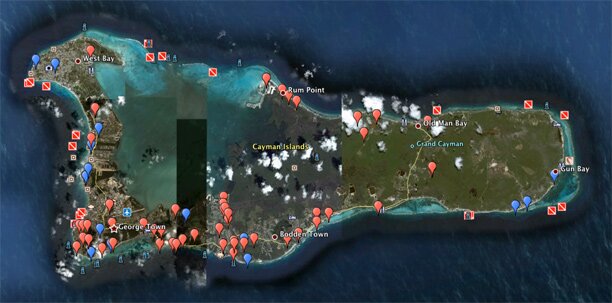
- - Bat house Locations on GoogleEarth - -
|
|
The following LINK is a file built from GoggleEarth that will let you see the data as well as the location of the bat houses on the Grand Cayman Island. To view this file you MUST have a copy of the program GoogleEarth on you computer.
This map includes the 2010 data points and counts.
|
|
click here to see < BathouseLocations_GoogleEarth >
|
| We have discovered that as of the posting of this link (May 2011), that the Safari web browser does not support this logic. |
There are 82 existing bat houses on Grand Cayman. We currently have 11,000 bats living in bat houses but this does not include our fruit bats or forest-dwelling species. We are pleased that the the 2010 data shows an increase in bat house populations despite recent observations of hawks and owls preying upon bats during the nightly fly-outs at dusk.
Bats using the bat houses are all presumed to be insectivorous Molossus molossus, though only an acoustic monitoring survey could verify this. Our greatest challenge is habitat conservation for the forest and cave-dwelling species that do not use bat houses.
The bat house project depends primarily upon the donation of utility poles from Caribbean Utilities Co Ltd (CUC) and has also received important support from Bat Conservation International, The British Bat Trust, The National Trust for the Cayman Islands, The Cayman Islands Department of Environment, Cayman Islands Public Works Department, Cayman Wildlife Rescue, Ron Moser's Machine Shop, CGMJ Architects, Mr. Kelly Hill, AL Thompson's Home Depot, The Frazier family, Alison Corbett and Jim Blumenthal. It has been in operation since 1993 and focuses on providing bat houses and solving roof-bat problems.
We are anxious to share our successes with others in the tropics and happily respond to email requests for more information. Please download the PowerPoint above for a basic explanation of how our program works.
Many thanks to the volunteers who helped to complete the 2009 and 2010 Cayman Islands bat house data.
We have a detailed Excel Chart available upon request of the bat house data.
|
| |
|
| |
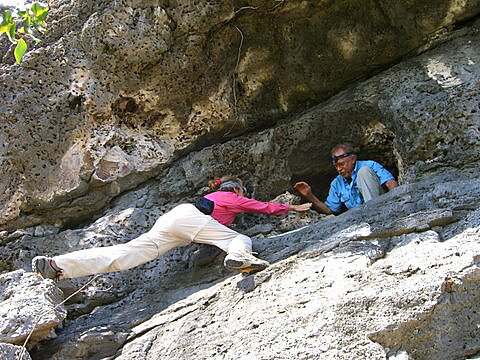 |
| Dr. Merlin Tuttle and his wife, Paula investigate a cave high on the bluff on Cayman Brac. Dr. Tuttle documented bat colonies in caves on all three islands to assess their potential as tourist attractions. He also mist-netted and assessed the status of rare Cayman Islands bat species in forests post-Ivan. He spoke to various governmental and non-governmental groups and appeared on CITN News. |
Photo by Lois Blumenthal |
|
| |
Dr. Merlin Tuttle is the Founder of Bat Conservation International. The international interest that Cayman Island species attract highlights the fact that the flora and fauna here are markedly different from other Caribbean islands due to our isolation in the sea. Already, ecotourists visit this website and www.nationaltrust.org.ky to learn more about our unique wildlife and natural habitats. The work of highly regarded scientists like Dr. Tuttle and so many others is published in the international press and locally both on-line and in magazines and newspapers. This type of work, and the publicity it generates can only result in more ecotourists discovering the wonders of the Cayman Islands.
|
| |
|
| |
| Bat Caves Must Not Be Disturbed |
|
Most caves in the Cayman Islands have had at least three species of bats in them. Sadly, human disturbance has drastically reduced the number of bats in our local caves. Deliberate vandalism, as well as innocent curiosity, has caused bats to leave most caves here. Caves in which mother bats give birth are called maternity caves. During the breeding season, males and non-breeding females roost in separate caves called bachelor caves.
Only certain caves are suitable, because bats need specific temperatures, humidity and low disturbance levels.
There is really no good way to observe bats caves without disturbing them. Flashlights, camera strobes, noise and movement all alarm the bats. It is especially important never to disturb the maternity caves during the breeding season.
|
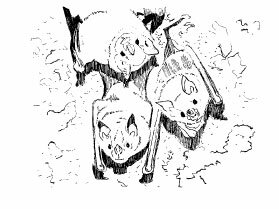 |
| Caribbean Fruit Bats often live in cave entrances |
|
|
| The large cave south of Old Man Bay once held more than 30,000 Brazilian Free-tailed Bats. In July 1970, between 2,000 and 5,000 bats were there. In January 1986, only about 1,000 Free-tails were counted. Today, there are no Brazilian Free-tailed Bats in this cave. The small group of Big-eared Bats that used to live in the extreme rear of the cave disappeared around 1990 but returned in June, 2010. We do not know if any bats survived the fires that were started inside their cave during the summer of 1995. About forty Caribbean Fruit Bats now live in the entrance. Since this cave once provided such excellent habitat, it is possible that bats could return to it someday if it is protected. It is hoped that our Free-tails are safe in an undiscovered cave somewhere. Only twenty-eight Brazilian Free-tailed Bats were found in 1998, in a remote cave in the interior of Grand Cayman Island. |
"When bats are disturbed during the summer months,
panicked mother bats may abandon
their young, thus losing an entire generation." |
|
The "Bat Cave" at Spotts on Grand Cayman has been on tourist maps for many years. This cave was once home to our largest colony of Big-eared Bats. It is now also deserted, probably because too many people disturbed the bats during the day while they were sleeping, or worse, during the summer when they were caring for their young. The best way to view bats is to watch the "fly-out" at dusk, and the best way to ensure a spectacular fly-out is to stay out of the caves so that the populations can grow.
No one should ever crawl into caves to look at bats without a trained scientist's advice. Panicked bats will abandon their young, and an entire generation can be lost. Bats may also feel forced to find a new home, perhaps moving into a less safe and less suitable spot.
The Cayman Islands have many caves. Tourists and local people visit them often, and they are a valuable attraction here. Rare and endangered species, like the Buffy Flower Bat, live in the dark and remote sections of some of these caves. These bats are extremely intolerant of human visitors and cannot live in places where they are disturbed by people. Buffy Flower Bats are environmentally important, rare, and endemic to the Caribbean. They must be protected. The beautiful cacti that cover the top of the Bluff on Cayman Brac need the Buffy Flower Bat for pollination. A way must be found to protect these and other rare bats, while still allowing people to enjoy parts of the caves not needed by these shy and sensitive animals. Bats are especially at risk during the summer months, between June and November, when the baby bats are born and are learning to fly.
|
 |
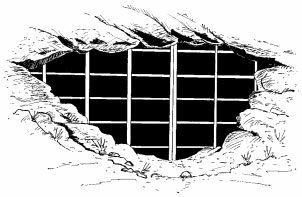 |
| Bat gates allow bats to come and go freely, while protecting them from curiosity seekers. Special doors can be built so scientists and guided tour groups can enter. |
|
| Bats and Tourism |
| The Cayman Islands are well known to tourists because of our wonderful undersea world. We are now trying to encourage visitors to enjoy the land-based treasures as well. A good bat cave is a wonderful tourist attraction. People gather in the evening on a deck near a well-populated cave and watch the emergence of thousands of bats. If people go inside the cave, bats will feel threatened and leave. Watching from the outside does not disturb the bats and provides an interesting experience for visitors. Tourists like to buy "batty" souvenirs and T-shirts after watching an emergence. There are several caves on Grand Cayman and on Cayman Brac with the potential for tourism, but these caves must first be protected so that large colonies of bats will be safe and undisturbed inside them. |
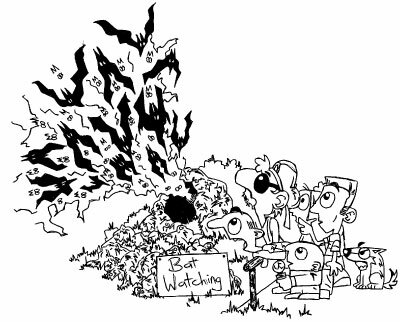 |
Tourists enjoy watching bats emerge from a cave.
Drawing: Billy Bryan |
|
It is not a good idea to visit bats in caves. Bats sleep during the day and do not like to be disturbed. This is especially important during the spring and summer when newborn pups are being cared for. Bats can become so frightened that they will even abandon their babies. Some of our most rare and special bats live in caves on Grand Cayman and on Cayman Brac.
Some kinds of bats are already disappearing, and we must all try to control our curiosity and leave them alone in their homes.
|
|
| In some places bats migrate long distances and spend their winters and summers in different places. Bats in the Cayman Islands stay all year long. In northern countries bats hibernate through the winter months deep in caves and old mine shafts. These bats die if they are awakened during the winter when there is no food. Our bats are active 12 monts a year. This means that a properly managed bat tourist attraction in the Cayman Islands could operate year-round. |
| On the Brac and in the Bluff |
|
There are six known species of bats living on Cayman Brac. They are the Velvety Free-tailed Bat, the Caribbean Fruit Bat, the Big-eared Bat, the Brown Bat, the Buffy Flower Bat, and the White-shouldered Bat.
"Known" is the key word here. A new species was just discovered on Grand Cayman last year. There is much still to learn about the mysteries of the Brac!
|
 |
|
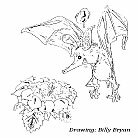
| The most easily found and most common bat on the Brac is the Caribbean Fruit Bat. This bat lives around the entrances to the caves and usually flies around inside the cave when disturbed during the day. This bat feeds mainly on fruit, but one-quarter of its diet is made up of insects found on the fruit and in the fruit trees. Wild almonds and the red seeds from Christmas palms are favourite foods. The chewed seeds can be found on the floors of the cave entrances and under feeding roosts in trees. This bat doesn't seem to mind a reasonable amount of human disturbance. It often takes up residence in caves after more easily frightened species have been driven away by too many visitors. |
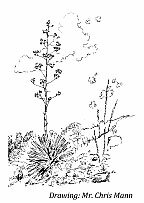 |
Luckily for the rest of Cayman Brac's species, there are many small caves and crevices in the Bluff that provide safe, private habitat where people never come. This is a very good thing because some of the Brac's most valuable bats, like the Buffy Flower Bat, cannot tolerate visits by human beings. The Buffy Flower Bat is the primary pollinator of the large cactus and agave plants growing on top of the Bluff; without it, these plants would die off. This bat has a long nose and an even longer tongue for drinking nectar. It has never been studied and little is known about its role in the ecosystem. This rare and beautiful bat is found only in the Cayman Islands and Jamaica. |
|
| Anyone visiting caves on Cayman Brac should be quiet and respectful of the sleeping animals there. People should avoid visiting caves during the summer as this may cause mother bats to abandon their babies in fright. |
 |
|
|
|
| |
|
| |
Cayman Airways is to be commended for their generous support of the National Trust Visiting Scientist Program which benefits not only pure science, but also conservation and our ecotourism product. Housing is donated by the Blumenthal and Bumgarner families and Gladys Howard of Pirates Point.Visit the "Press" page on this site for more on the National Trust Visiting Scientist Program.
|
| |
|
| |
We support Bat World Sanctuary in their on-going and pioneering efforts to save America's bats. Please visit www.batworld.org and www.amandalollar.com
|
| |
|
| |
POSITION STATEMENT ON BAT RESEARCH AT TEXAS A&M UNIVERSITY
February 27, 2009
We support the position of Bat World Sanctuary and the like-minded bat and animal welfare groups listed on this (PDF document from FACEBOOK will be downloaded).
|
| |
|
|
|
GENERAL INFORMATION ABOUT CAYMAN ISLANDS BATS
Bats are extremely vulnerable to extinction because they bear only one young per year and because they often live in large colonies that can easily be wiped out by one misguided or uninformed person.
Most people do not realize how important bats are to a balanced ecology. They control night-flying insects including many kinds of crop and garden pests as well as mosquitoes. They also pollinate hundreds of native plants such as the agave, silk cotton, naseberry, vine pear, neem, cactus, calabash and many others. Bats also disburse seeds throughout the islands, helping to keep our forests healthy and diverse.
There are nine species of bats in the Cayman Islands, our ONLY native mammals. Each of these specializes in a different type of food and each has a different role in the ecosystem. All of our subspecies are endemic to the Caribbean with one endemic to Grand Cayman
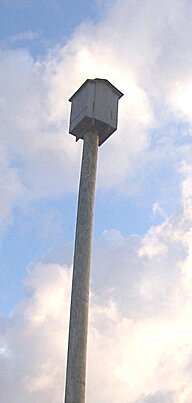
One of the most common species is often found in roof spaces where the droppings can eventually cause odor problems. With the generous cooperation of Caribbean Utilities Co., Ltd (CUC) the Bat Conservation Project has erected over 70 bat houses on utility poles all over Grand Cayman. (Cayman Brac has little need for bat houses because there are so many crevices in the Bluff.) These bat houses provide alternative habitat and help to keep bats from moving into human structures. The Cayman Islands is one of only two places in the world to attract Velvety Free-Tailed Bats to bat houses and our program is the most successful in the entire Caribbean. Bat houses are still experimental in the tropics and the Bat Conservation Project is trying several new designs. They provide free property inspections and advice about how to remove bats safely and permanently from roof spaces.
There are no Vampire Bats in the Cayman Islands. While some Caribbean islands do have a bat known as a “Vampire” this tiny creature is mainly a pest to cattle ranchers and is not a threat to humans.
Bats are the only mammals that can fly. Bats can live up to 30 years. They evolved 60,000,000 years ago and have lived in the Cayman Islands for 25,000 years
Only two of our nine species eat fruit, but fruit bats also eat pollen and nectar and are of great benefit because they pollinate fruit trees. Twenty-five percent of a fruit bat’s diet is made up of insects found on or around fruit trees. These bats also eat overripe fruits missed by pickers and wild fruits that would otherwise rot and provide breeding grounds for fungus, fruit flies and other pests. In places where fruit bat populations have been eliminated, fruit losses actually increased, sometimes to the point where the farming of soft-skinned fruits had to be abandoned. Fruit bats are too large to use bat houses, which are designed for insect-eating species. The Cayman Islands Bat Conservation Project has information to help farmers protect their fruits from damage by bats.
Caves provide crucial habitat for bats. Cave visitors should be calm and quiet and never shine flashlights or camera strobes on sleeping bats. Never enter caves inhabited by bats during the spring or early summer months when newborn baby bats are present. Disturbance during this time can cause the mother bats to abandon the roost, leaving flightless babies to die as a result.
Though the Cayman Islands have nine species of bats, we have ten different kinds. The Brown Bat is present in two separate subspecies. Based upon its smaller size and darker colored fur, the Grand Cayman Brown Bat is considered to be an endemic sub-species not yet named.
Many Thanks to Courtney Platt and Merlin Tuttle for these copyrighted bat portraits.
CAYMAN ISLAND'S BATS:
|
|
|
|
|
|
|
|
|
|
|
|
|
|
|
|
|
|
|
|
|
|
|
|
|
| |
|
|
|
|
|
Common Name
|
Classification
|
Diet
|
Status
|
Distribution
|
| Family: Phyllostomidae |
|
|
|
|
| Subfamily: Phyllostomatinae |
|
|
|
|
|
Big-eared Bat
|
Macrotus waterhousii minor |
Insectivore |
Rare |
Bahamas, Cayman Islands, Cuba |
| Subfamily: Stenoderminae |
|
|
|
|
|
Caribbean Fruit Bat
|
Artibeus jamaicensis parvipes |
Frugivore |
Common |
Bahamas, Cayman Islands, Cuba, Turks & Caicos |
|
White-shouldered Bat
|
Phyllops falcatus |
Frugivore |
Very Rare |
Cayman Brac, Cuba, Grand Cayman, Haiti |
| Subfamily: Phyllonycterinae |
|
|
|
|
|
Buffy Flower Bat
|
Erophylla sezekorni syops |
Pollen-eater |
Very Rare |
Cayman Brac, Grand Cayman, Jamaica |
|
Antillean Fruit & Nectar Bat
|
Brachyphylla nana nana |
Frugivore |
Rare |
Cuba (Isle of Pines), Grand Cayman |
| Family: Vespertilionidae |
|
|
|
|
|
Big Brown Bat
|
Eptesicus fuscus dutertreus |
Insectivore |
Rare |
Cayman Brac, Cuba |
|
Brown Bat
|
Eptesicus fuscus spp. nov. |
Insectivore |
Very Rare |
Grand Cayman |
|
Red Bat
|
Lasiurius spp unconfirmed |
Insectivore |
Very Rare |
Unconfirmed |
| Family: Mollossida |
|
|
|
|
|
Brazilian Free-tailed Bat
|
Tadarida brasiliensis muscala |
Insectivore |
Rare |
Cuba, Grand Cayman |
|
Velvety Free-tailed Bat
|
Molossus molossus tropidorhynchus |
Insectivore |
Common |
Cayman Brac, Cuba, Grand Cayman |
|
|
Please CONTACT US or phone for more information on Cayman Islands Bats. You may also visit the National Trust to ask for information sheets “Bats in the Roof Space – What to Do”, “Why Put Up a Bat House”, How and Where to Mount Your Bat House”, “Plans for Mounting a Double Bat House on a Utility Pole”, “Fruit Bats – The Real Story” – these, children's educational materials, and more are available free from the CI Bat Conservation Project or through the National Trust for the Cayman Islands. Some of this information can be found at www.nationaltrust.org.ky/info/bats.html Information about bats worldwide can be found at www.batcon.org, www.batconservation.org.
|
|
|
Please check out this other valuable information we have on Cayman Islands Bats:
| Some of the above files will download in Microsoft WORD or a web page format |
| the others will download in Adobe Acrobat Reader (PDF) format. |
 |
|
|
|
If you find an injured or young bat and need expert help:
In the Cayman Islands, phone:
- The Bat Conservation Programme
- The Wildlife Rescue Centre
- Island Veterinary Services
For help outside the Cayman Islands and the Caribbean, please contact Amanda Lollar, Director of Bat World at:
Web Site: BatWorld.org
E-mail:
Mailing address:
Bat World Sanctuary
Remember, never touch a bat with your bare hands - if you do it is required in the United States that the bat be destroyed.
|
|
|
To join & subscribe to the Caribbean Bats e-group send email to:
This group connects over fifty members from all over the Caribbean. Messages are infrequent, but this is an important forum for announcements about upcoming Caribbean bat workshops and events, and the archive is available to new members so that they may review information that has been contributed in the past.
|
|
|
To discuss the technical aspects of building and erecting bat houses join & subscribe to Bat House Journal by sending email to:
|
|
|
Our Bat Program Partners & Sponsors
|
|
|
|
| |
|
|
|
|
|
| |
- top of page -
|
|
| |
| |
|
Amphibians & Reptiles
|
|
INTRODUCTION TO CAYMAN ISLANDS’ AMPHIBIANS AND REPTILES
|
| |
We are grateful to the authors of The Cayman Islands Natural History and Biogeography edited by M.A Brunt and J.E. Davies. The invaluable herpetological section was authored by Dr. M. E. Seidel and Dr. R. Franz. This important book compiles numerous bodies of research done about Cayman Islands fauna. We also thank Dr. Blair Hedges of Pennsylvania State University for answering our questions. We look forward to Dr. Hedge’s upcoming field guide to the 750 species of Caribbean Reptiles and Amphibians. Mr. Fred Burton, Director of the Cayman Islands Blue Iguana Project provided essential advice as well. We especially thank Mrs. Mars Van Liefde for her keen observational skills and deep knowledge of Cayman’s animals and their behaviours, and Lois Blumenthal for compiling this data as a quick reference for students of nature.
Although the species of herpetofauna in the Cayman Islands has been well documented, there is very little ecological information available for most species. The Cayman Islands Natural History and Biogeography states, "Students of nature who live in these islands can make important contributions by keeping records of their observations. Such records could help to establish priorities leading to proper management for the preservation of these important components of the country’s natural heritage."
|
| |
|
| |
| Note: |
|
Some species have more than one common name. On this chart, we have used the North American common names first, followed by the Cayman Islands names if they are different. |
|
| |
|
| |
|
To download a print-friendly version of the Amphibians and Reptiles information,
please click < here >
The file will download in Microsoft WORD format
|
|
| |
|
| |
Terrestrial Amphibians and Reptiles in the Cayman Islands
|
|
Grand Cayman (GC) Cayman Brac (CB) Little Cayman (LC)
|
Amphibians
|
Status |
Species also indigenous to: |
| Frogs |
| Family: Leptodactylidae |
|
Greenhouse Frog
|
Eleutherodactylus planirostris |
GC, CB |
Indigenous |
Cuba, Bahamas |
| Family: Hylidae |
|
Cuban Treefrog, Bullfrog
|
Osteopilus septentrionalis |
GC, CB, LC |
Indigenous |
Cuba, Bahamas |
Reptiles
|
| Crocodiles |
| Family: Crocodylidae |
|
American Crocodile, Crocodile
|
Crocodylus acutus |
CB, LC |
Rare visitor |
S. Florida, S. & C. America, Cuba, Jamaica, Hispaniola |
|
Cuban Freshwater Crocodile
|
Crocodylus rhombifer |
GC |
Extirpated |
Cuba |
| Freshwater Turtles |
| Family: Emydidae |
|
Taco River Slider, Hickatee
|
Trachemys decussata angusta |
GC, CB |
may be introduced (well established) |
Cuba |
| Lizards |
| Family: Iguanidae |
|
Blue-throated Anole, Chameleon
|
Anolis conspersus conspersus |
GC |
Endemic species |
|
|
Blue-throated Anole, Chameleon
|
Anolis conspersus lewisi |
GC |
Endemic species |
|
|
LC Green Anole
|
Anolis maynardi |
LC (introduced to CB) |
Endemic species |
|
|
Cuban Brown Anole, Bush Lizard
|
Anolis sagrei sagrei |
CB, LC (introduced to GC) |
Indigenous |
Cuba, Bahamas, Jamaica, coastal Central America |
|
Brown Anole
|
Anolis sagrei luteosignifer |
CB |
Indigenous |
Cuba, Bahamas, Jamaica, coastal Central America |
|
GC Blue Iguana
|
Cyclura nubile lewisi |
GC |
Endemic species |
|
|
Lesser CI Iguana, Rock Iguana
|
Cyclura nubila caymanensis |
CB, LC |
Indigenous |
Cuba |
|
Curly-tailed Lizard, Lion Lizard
|
Leiocephalus carinatus varius |
GC |
Indigenous |
Bahamas, Cuba |
|
Curly-tailed Lizard, Lion Lizard
|
Leiocephalus carinatus granti |
CB, LC |
Indigenous |
Bahamas, Cuba |
| Galliwasps |
| Family: Anguidae |
|
Galliwasp
|
Celestus crusculus maculates |
CB, LC |
Indigenous |
Jamaica |
| Geckos |
| Family: Gekkonidae |
|
Wood Slave
|
Aristelliger praesignis praesignis |
GC, CB, LC |
Indigenous |
Jamaica |
|
Ground Gecko, Wood Lizard
|
Sphaerodactylus argivus argivus |
GC, CB, LC |
Endemic species |
|
|
Ground Gecko, Wood Lizard
|
Sphaerodactylus argivus lewisi |
GC |
Endemic species |
|
|
Ground Gecko, Wood Lizard
|
Sphaerodactylus argivus bartschi |
LC |
Endemic species |
|
| Snakes |
| Family: Colubridae |
|
Racer, Ground Snake, Black Snake
|
Alsophis cantherigerus caymanus |
GC |
Indigenous |
Cuba |
|
Racer, Ground Snake, Black Snake
|
Alsophis cantherigerus fuscicauda |
CB |
Indigenous |
Cuba |
|
Racer, Ground Snake, Black Snake
|
Alsophis cantherigerus ruttyi |
LC |
Indigenous |
Cuba |
|
Water Snake
|
Tretanorhinus variabilis lewisi |
GC |
Indigenous |
Cuba |
| Family: Tropidophiidae |
|
Ground Boa, Lazy Snake
|
Tropidophis caymanensis caymanensis |
GC |
Endemic species |
|
|
Ground Boa, Lazy Snake
|
Tropidophis caymanensis parkeri |
LC |
Endemic species |
|
|
Ground Boa, Lazy Snake
|
Tropidophis caymanensis schwartzi |
CB |
Endemic species |
|
| Family: Typhlopidae |
| Blind snake |
Typhlops caymanensis |
GC |
Endemic species |
|
| Blind Snake |
Typhlops epactia |
CB |
Endemic species |
|
Exotic (non-native) Species
Recently Introduced
|
Country of Origin |
|
Eastern Narrowmouth Toad
|
Gastrophryne carolinensis |
GC |
Introduced (well established) |
S.E. USA |
| Cane Toad |
Bufo marinus |
GC |
Introduced |
South America |
| Green Iguana |
Iguana iguana |
GC |
Introduced |
Central America |
| Tropical House Gecko |
Hemidactylus mabouia |
GC, CB, LC |
Introduced |
S.America/Africa |
| Eastern Glass Lizard |
Ophisaurus ventralis |
GC |
Introduced |
Florida |
|
Corn Snake
|
Elaphae guttata |
GC |
Introduced |
Florida |
| Brahminy Blind Snake, Flowerpot Snake |
Ramphotyphlops braminus |
GC |
Introduced |
Pacific Asia |
| Red-eared Slider, Red-eared Turtle |
Trachemys scripta |
GC |
Introduced |
Southeastern United States |
| Yellow-headed Gecko |
Gonatodes albogularis |
GC |
Introduced |
Central America |
|
| |
|
| |
Here is a link to Caribherp - a listing of West Indian reptiles and amphibians. Lists include Cuba, Jamaica, Hispaniola, Puerto Rican Bank, Lesser Antilles, Bahamas and the Cayman Islands.
|
|
- top of page -
|
|
| |
|
Crabs
|
|
|
| |
|
Land Crab
|
| |
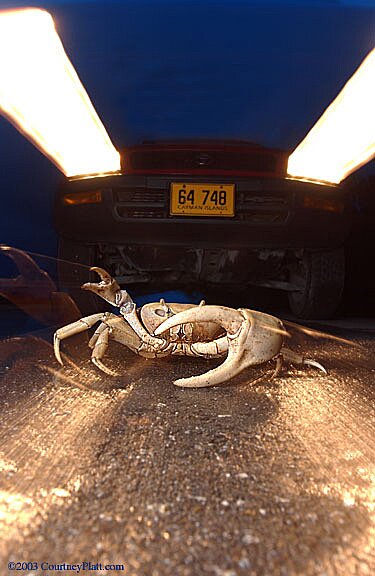 |
| Many thanks to Courtney Platt (www.courtneyplatt.com) and to Denise Bodden for the use of this photo. Copyrights for all photos on this website remain with the photographers. |
|
| |
Land Crabs: There are a variety of species, but detailed studies are scarce. "Ghost Crabs" are whitish and translucent and can be found on beaches living in the sand. After storms, "Hurricane" crabs are seen by the thousands, and different species of Land Crabs live mostly behind beach ridges and make their way to the sea to spawn.
Land Crabs will clean your garden, removing dead insects and dog droppings and even capturing and eating cockroaches!
They need to keep their gills wet so they excavate a burrow down to the water table. They toss up anything in their way as they tunnel, including bits of antique pottery shards. Maybe Blackbeard's treasure will finally be found when a Land Crab tosses up a gold doubloon! This tunneling can be viewed as a nuisance by those who value a smooth green lawn - an uphill battle anyway next to the sea! Look into landscaping designs that incorporate pathways and natural vegetation to reduce your workload. Some people think these interesting, brightly-colored, small native animals are as beautiful as the flowers! Use pavers on your pathways to avoid stepping in their holes and allow Land Crabs to share your seaside home. Land Crabs will munch planted vegetables and many a gardener has been surprised to find newly sprouted vegetables eaten down to nubs overnight. Solve this problem with elevated beds and flower pots. Out-smart and Out-think them. Because Land Crabs live close to the sea, resorting to poisons damages the reef and may harm birds that depend upon them for food like the Cayman "Crab-catcher" (Yellow-crowned Night Heron). The Biogeography of the Cayman Islands suggests that crabs may fill the ecological niche of rabbits and mice - living in burrows and eating vegetation. These crabs must go to the sea to spawn and are often crushed by cars as they cross roads. There have been discussions for many years about how to avoid this problem, but sadly Land Crabs still have to run this gauntlet every year to spawn and it is obvious to local people, (who enjoy harvesting the feast) that the numbers have gone steadily down in recent years.
|
|
|
|
| |
- top of page -
|
|
| |
|
|