About Us

 
Cayman Wildlife Connection is a network of interested people who hope to conserve the Cayman Islands’ unique flora & fauna by encouraging individuals to landscape with native plants, by promoting the understanding that it is economically feasible to retain original vegetation during development and by connecting with existing organizations to highlight native flora and fauna as a part of the Cayman Islands’ national identity. We hope to cultivate the love of nature for its own sake and to underscore the educational value and tourism benefits of local plants as well as foster the awareness that native vegetation is vital to the survival of native butterflies, birds and other wild animals in the Cayman Islands.
"A network is non-hierarchical. It is a web of connections among equals. What holds it together is not force, obligation, material incentive, or social contract, but rather shared values and the understanding that some tasks can be accomplished together that could never be accomplished separately. One of the important purposes of a network is simply to remind its members that they are not alone."  Meadows, Meadows and Randers - Beyond the Limits (1992)
 
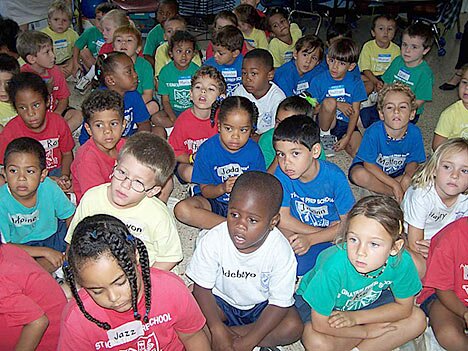
These are some of the children of the Cayman Islands; They trust us - let's save some of the special beauty of the Cayman Islands for them, and for all our children, grandchildren and the generations to come

"Both geographically and culturally, the Cayman Islands are unique in the Caribbean area. However, they share with other countries the challenge of controlling progress so that the natural environment does not suffer irreparable damage." A Guide to the Natural History of the Cayman Islands: a publication of the Cayman Islands Conservation Association, (CICA) produced in 1976 by Cayman Free Press Ltd.and dedicated to the children, in whose hands the future lies. Like CICA so many years ago, Cayman Wildlife Connection is inspired by the desire to preserve the natural environment for our children and grandchildren to enjoy. We believe that by incorporating native plants into home landscaping and learning to understand and live with our native wildlife and butterflies we can integrate nature into our daily lives. Though preservation of wild habitats is of paramount importance, to divide the world into “them and us” – to attempt to put all wildlife and natural vegetation into parks will not be enough. Everyone can help by making their backyard gardens into mini-habitats for butterflies and other wild creatures.


This web site is still under construction. Please bear with us. We have many beautiful and educational photos to post and much information to share, but it will take us time to bring it all online. Please CONTACT US for advice about native plant landscaping in the Cayman Islands. Watch this site as it grows!

Cayman Wildlife Connection has no paid staff or office.  We are not funded and do this work on our own time. Our motivation is preservation and conservation of Cayman Islands’ unique biodiversity for our children and grandchildren by enthusing others to make their own contribution in their own way --- a lot of people doing a little.  We have "delegated ourselves" as a recent Public Service announcement on Radio Cayman suggested! We hope to show ordinary people how to help preserve native plants, butterflies and all Cayman Islands wildlife by creating backyard habitats and encouraging the preservation and planting of native trees and plants. 

Butterflies cannot survive without their larval food plants and this quite often means native plants that are considered “weeds”. Cayman Wildlife Connection hopes that as interest grows, more local nurseries will begin propagating native plants for local use. Sometimes it is only a matter of leaving nature alone. Do you have a place where weeds, wild flowers and shrubs can grow naturally for Cayman's 50 species of butterflies? A small butterfly zone in your garden can be encouraged and maintained by using the plants that might naturally spring up. CWC will provide help and information so that these areas can be optimized to benefit as many species of butterflies as possible. Please don’t forget the larval food plants! Caterpillars are your future butterflies. 


This website is deeply indebted to Ann Stafford of CaymANNature for inspiration and all butterfly & moth identifications and data. Currently, it is updated regularly and lovingly tended by Lois Blumenthal on behalf of the wild animals of the Cayman Islands. The site is donated and maintained by Reid A. Weske of California WebWise.
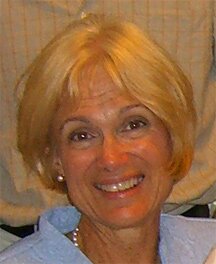
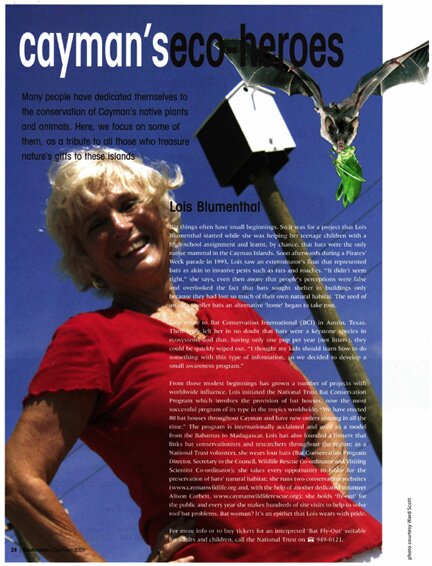
Lois Blumenthal initiated the National Trust Bat Conservation Programme for the Cayman Islands in 1992. It is the most successful in the Caribbean and is internationally acclaimed as a prototype for tropical countries worldwide. She is the Caribbean Coordinator for Bat Conservation International and founded a listserv that links bat conservationists and researchers throughout the region. Details of her program, including sample press releases and educational resources are available free through this website, which also features descriptions and photos of some of the Cayman Islands' distinctive flora and fauna. This work is not complete (and may never be!) - new photos are added as they become available.She is a Lifetime Member of the National Trust, has served on the Trust Council since 1994 and currently serves on the Executive Committee as Secretary.

On behalf of the National Trust, she established the Wildlife Rescue Centre (917-BIRD) and served as manager until 2007. She volunteered in the National Trust Blue Iguana Recovery Programme (BIRP) since 1993 where she initiated and coordinated the fresh fruit and vegetable project resulting in the first successful hatchings in two years.

Ms. Blumenthal has written numerous pamphlets, brochures, magazine and newspaper articles about conservation for both local and international publications. Materials written for local schools include The National Symbols Study Guide and The Coral Reef Colouring Book.  She wrote the Mastic Trail Guide; and is co-author of Landscaping with Cayman Islands Native Plants for Butterflies & Wildlife.

With local and international photographers, she developed an educational slide show for schools (K through University), available free on this website. She speaks in classrooms and leads nature walks for students, including youth at risk. She has been a featured speaker for Rotary Club, Lions Club and other service clubs and for the National Trust's "Know Your Islands" Programme.

She is an avid naturalist and an advocate for the conservation of nature through cooperative means. As past president of the Garden Club of Grand Cayman, she spear-headed beautification projects including Sea-Farer's Hall and the Mission House as well as assisting schools, churches, nurseries and gardeners to landscape with Cayman Islands native plants. She believes that a closer connection to the natural world is highly beneficial and creates a more positive outlook in young people and adults and she feels strongly that the community as a whole benefits socially and economically from the preservation of unique native plants, wildlife and ecosystems.

She has been a regular visitor to the Cayman Islands since 1975 and in 1990 moved there permanently with her family.


Many Thanks to Cayman Airways for their continuing support of the National Trust Visiting Scientist Program

For the past several years, Cayman Airways has assisted the National Trust for the Cayman Islands in support of scientific work being conducted on all three Cayman Islands.

This year, in mid-January, Dr Richard R. Askew and his artist/photographer wife, Margaret, visited Grand Cayman, Little Cayman and Cayman Brac to photograph Cayman’s wild butterfly population and to update research on butterfly species here for their new book Butterflies of the Cayman Islands. This will be the first book of Cayman’s butterflies and it will help to promote their conservation, as well as eco-tourism on all three islands.

Dr. Askew originally described the Cayman Islands butterfly species in 1975. He wrote the descriptions for all the butterfly stamp issues over the years and Mrs. Askew has done both the photography and the artwork for them. Students and interested local naturalists often accompany Dr. Askew while he is working in the field and he avails us of the opportunity to do presentations to the public whenever he is in the Cayman Islands.

During early February, Dr. Merlin Tuttle, Founder and CEO of Bat Conservation International (www.batcon.org) visited all three islands as well. Dr. Tuttle documented bat colonies in caves to assess their potential as tourist attractions. He also mist-netted and assessed the status of rare Cayman Islands bat species in forests post-Ivan. He spoke to various governmental and non-governmental groups and is appeared on CITN News.

The international interest that Cayman Island species attract highlights the fact that the flora and fauna here are markedly different from other Caribbean islands due to our isolation in the sea. Already, eco-tourists visit this website and www.nationaltrust.org.ky regularly to learn more about the unique wildlife and natural habitats. The work of these two highly regarded scientists will be published in the international press and locally. This type of work, and the publicity it generates can only result in more eco-tourists discovering the wonders of the Cayman Islands.

Cayman Airways is to be commended for their generous support of this National Trust program which benefits not only pure science, but also conservation and our eco-tourism product. Housing for both groups has been donated by local families and Pirates Point.Visit the “Press” page on this site for more on the National Trust Visiting Scientist Program. Abbreviated CVs for both scientists appended here.

Richard R. Askew PhD, FRES - Cayman Islands Visiting Scientist
Dr. R. R. Askew was first involved in the biology of the Cayman Islands as the Entomologist on the Royal Society Expedition to the Islands in 1975 and wrote the chapter on entomology in The Cayman Islands: Natural History and Biogeography (eds Brunt and Davies 1994, Kluwer Academic Publishers), a standard text on the natural history of the islands.

Since 1975 he has made regular return visits to the islands, monitoring in particular population changes in Lepidoptera. These observations have been documented on each occasion and reports lodged with the Dept of Environment, the MRCU and the National Trust.

The book Butterflies of the Cayman Islands, is intended mainly as a comprehensive identification guide to the 50 or so species that are known from the islands, and it is aimed at residents, local school children and the very many visitors who come ashore from cruise ships as well as those who stay on the islands. It is written in easily understandable terms but nevertheless includes observations on quite technical subjects such as species-area relationships, mimicry, warning colouration and chemical defences. A particular feature of the book is the emphasis on identifying larval food plants and nectar resources of adults.

Until retirement Dr. Askew was Reader in Entomology at the University of Manchester and continues to be actively involved in research. He is the author of Dragonflies of Europe. This is a standard text on dragonfly identification and went to a second edition in 2004.

Summary Vitae - Dr. Merlin Tuttle, Founder and President, Bat Conservation International
Last revised: 7/26/07

Dr. Merlin Tuttle is an ecologist, award-winning wildlife photographer, and leading conservationist who has studied bats and championed their preservation for more than 45 years.

He is known worldwide through his scientific discoveries, media appearances, popular articles, and photographs, including expositions from Harvard University to the British Museum, and numerous feature articles that include the Wall Street Journal, The New Yorker and National Geographic.

He founded Bat Conservation International (BCI), an organization devoted to research, education and conservation of bats, in 1982. BCI emphasizes broad collaboration that balances both human and wildlife needs and has become a model for positive, no-conflict solutions. Against all odds, BCI has grown rapidly and now employs 30 biologists, educators, and administrators, supported by 13,500 members in 70 countries. It has gained permanent protection for many of the world’s largest remaining bat populations, has sponsored research to document the vital ecological and economic roles of bats, has trained hundreds of leading wildlife managers, and has vastly improved the public’s perception of bats.

He has been widely acknowledged for these achievements. In 1986, his research accomplishments were recognized through the Gerrit S. Miller, Jr. Award, the highest international honor conferred by colleagues in the field of chiropteran biology. In 1991, he received The Society for Conservation Biology’s Distinguished Achievement Award, honoring the accomplishments of Bat Conservation International. In 1997, he received both the National Fish and Wildlife Foundation’s Chuck Yeager Award and the Chevron/Times Mirror Magazine’s Conservation Award. In 1999, he was honored by United for Conservation in Mexico and won the $10,000 grand prize in the country’s first nature photography contest. Dr. Tuttle also received the National Wildlife Federation’s prestigious National Conservation Achievement Award for 2001. In 2002, The U.S. Postal Service featured four of Dr. Tuttle’s photographs in a commemorative stamp series. In 2003 Dr. Tuttle received the Margaret Douglas Medal for notable service to conservation education from The Garden Club of America, and in 2007 he received a U.S. Congressional Award on behalf of the achievements of Bat Conservation International.

OTHER AWARDS
Additionally, BCI received three national awards for Dr. Tuttle’s work on the Discover Bats! Video and educator’s handbook on bats: the 1998 Communicator Award of Distinction for Environmental Issues, the 1998 Telly Award for the Non-broadcast Film Category (Nature & Wildlife), and the 1999 Apple Award from the National Educational Media Network.

PUBLICATIONS
Dr. Tuttle has authored 48 research publications and dozens of popular articles. His popular book, America’s Neighborhood Bats, and the Bat House Builder’s Handbook both rank among the University of Texas Press’ all-time best sellers.

LECTURES, SEMINARS
Dr. Tuttle has been invited to speak in many of the world’s most prestigious lecture halls. He has given more than 200 major public lectures and research seminars, including at: Harvard, Yale and Cornell Universities; the American Museum of Natural History, The Los Angeles County Natural History Museum, the Field Museum, the Shedd Aquarium, the British Museum, South Africa’s Durban Natural Science Museum, and the Smithsonian Institution; Sydney, Australia’s Taronga Zoo, the U.S. National Zoo, and the Brookfield Zoo; and the National Geographic Society Headquarters.

SELECTED TELEVISION AND RADIO APPEARANCES

  • In 1984, Dr. Tuttle’s conservation efforts were featured in a widely aired National Geographic Television special, titled Merlin’s Bats.
  • In 1985, Tuttle’s research was featured in the BBC Special, The Bat That Cracked the Frog Code, which aired throughout Europe and the U.S.
  • In 1990, Tuttle and his conservation efforts were featured in the Survival Anglia production, The Secret World of Bats, which premiered on CBS television and subsequently aired in more than 100 countries. Dr. Tuttle was the Scientific Advisor who planned and participated in this award-winning documentary that continues to air on cable television shows such as the Discovery Channel and Animal Planet.
  • In 2006, Dr. Tuttle’s lifelong conservation successes were featured in Merlin Tuttle, Guardian Angel of Bats, part of the MONA LISA & Mandarava Productions, “Heroes of Nature” television series which aired throughout Europe.
  • Dr. Tuttle’s other TV appearances include ABC’s Good Morning America, and World News Tonight; NBC’s Today Show, Dateline, and David Letterman Show; CBS’s Evening News; PBS’s Charlie Rose Show; the Discovery Channel, National Geographic Explorer, National Public Radio, and Voice of America, among many other television and radio interviews worldwide.

FEATURE ARTICLES
BCI’s accomplishments have been featured in most of the world’s major newspapers and magazines, including National Geographic, Smithsonian, Modern Maturity, The New Yorker, Time, People, Geo, Reader’s Digest and Stern magazines and most of the major metropolitan newspapers of the U.S. including the New York Times, Wall Street Journal, Los Angeles Times, Chicago Tribune, Houston Chronicle, and Washington Post. International newspaper articles include the China Morning Post, Indonesian Times, Sydney Morning Herald, London Times, and many others.

WILDLIFE PHOTOGRAPHS
Thousands of publications, exhibits, and Web sites of a wide variety worldwide have featured Dr.Tuttle’s photographs. These include five National Geographic articles, more than a dozen National Geographic Society books and other magazines, and inclusion in their prestigious publication, 100 Best Pictures. His photographs in “Masters of the Night: The True Story of Bats” traveling exhibit have helped educate more than two million people in a decade of touring the United States, Canada, Mexico and Europe. A special 2002 commemorative stamp series by the U.S. Postal Service also featured Tuttle’s photographs.


 Grow Cayman Plants, encourage Cayman wildlife!