|
|
Fascinating article by Naqqi Manco about Sea Beans on page 24 - click < here >
|
|
|
|
Cut Flowers and Pesticides
Giving a gift of cut flowers may not be the wonderful expression of love that you intend it to be. That's because whenever you or a loved one touches the flowers or inhales the scent of your conventional bouquet, you are probably touching or inhaling poisonous chemicals. The floral industry is one of the heaviest users of hazardous agricultural and processing pesticides. In addition, the majority of flowers sold in North America are imported from countries like Ecuador and Columbia, where labor practices are sometimes questionable. Studies by the International Labor Organization and Ecuador's Catholic University have found that many farm and post-harvest workers complain of pesticide-poisoning symptoms. Women, who represent 70 percent of all rose workers, experience significantly elevated rates of miscarriages and birth defects.
If you plan to give cut flowers - or, in fact, to buy them as a gift or for yourself at anytime during the year - Pick them yourself in a friends garden or look for Cayman's beautiful and under-appreciated wild flowers in a field or forest. Make a responsible, healthy choice.
New, greener, fair-trade commercial cut flowers are in the pipeline - they are becoming available in other countries and we hope soon in Cayman - ask your flower vendor about organic fair-trade flowers, pick your own, or, when you need a gift for a special friend try fair-trade organic chocolate - or better yet a box of organic strawberries! Keep your day as well as women workers in poor countries, and the planet healthy.
Read www.sierraclub.org/sierra/200107/hidden.asp - and look for more about this on-line. It's a dirty secret!
|
|
|
 |
|
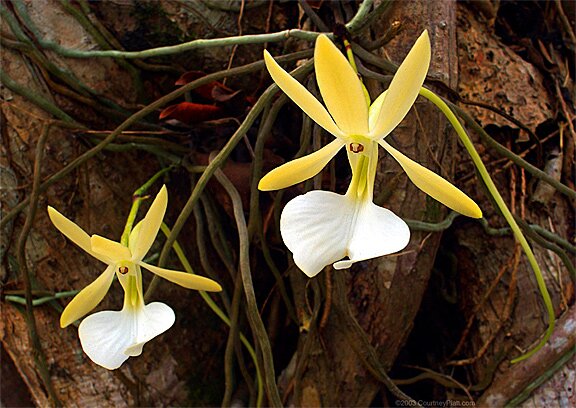
Grand Cayman's rare, endangered and endemic Ghost Orchid Dendrophylax fawcetti - for more on efforts to preserve this orchid visit www.ironwood-forest.com and www.caymannewsservice.com
|
Photo by Courtney Platt
|
|
|
 |
| Wild Banana Orchid (Myrmecophila thomsoniana - syn. Schomburgkia thomsoniana - endemic to Grand Cayman Island - common in forests and gardens. |
Photo by Sonny Rivers
|
|
|
 |
Wild Banana Orchid on Cayman Brac blooming in late April - To download a children's story about this beautiful endemic orchid click < here >.
(The file will download in Microsoft WORD format)
|
Photo by Wallace Platts
|
|
|
 |
Wild Banana Orchid on Cayman Brac
May 2009 |
Photo by Wallace Platts
|
|
|
 |
Wild Banana Orchid on Cayman Brac
May 2009 |
Photo by Wallace Platts
|
|
|
 |
| Headache Bush (Capparis cynophallophora) in blossom on Cayman Brac, May 2008 |
Photo by: Win Thu Aung
|
|
|
|
"There are about 700 plants growing wild in the Cayman Islands. The information presented here is just the beginning. We encourage everyone to use the links and publications recommended on this site to do their own research and learn more about Cayman Island's rare, endemic, culturally significant and fast-disappearing native trees and plants.
|
|
Native Trees - What Are They
|
 |
A Cayman Islands native species is one that occurs naturally in the Cayman Islands without direct or indirect human actions. Some plants and animals are native to only one or two of the three Cayman Islands.
There is much discussion since Hurricane Ivan about replanting with native trees, but not everyone is clear about exactly what a native tree is! Some trees that we like very much, like mangoes are not native, but that doesn't mean that we shouldn't plant them anyway! Mangoes are not Invasive and that is the important distinction the place where the line is drawn between welcome and unwelcome foreign plants just as it is drawn between welcome and unwelcome foreign visitors of any other species, including humans! While mangoes are not native, they have been naturalized and there is general agreement that they have been given "Status" and have become part of the local way of life.
Native or Indigenous mean the same thing found here naturally, and have been growing in the Cayman Islands for thousands of years but can also grow in other places like Jamaica, Cuba, Florida Haiti, the Bahamas, etc. Though they have been replaced by imported plants in the more developed areas, they still survive on pockets of undeveloped land all over the islands.
Endemic those species that are found only here in the Cayman Islands and nowhere else on Earth.
Opportunistic native or non-native plants that can become pests when the land is disturbed. For instance Maidenplum springs up where forests have been cleared.
Useful? Sometimes the usefulness of a plant is not immediately apparent. As we clear "useless bush" we may be removing food and nesting sources for wildlife, causing parrots and other birds to seek cultivated crops or to roost in buildings.
Many plants regarded as "weeds" are in fact vital food sources for native butterflies. Even dead trees support wildlife, by providing nesting cavities and even food for birds. Parrots build nests in dead Royal Palm trunks, and woodpeckers will nest in cavities as well as eat insect infestations in dead wood.
Historically, Caymanians used local plants for hundreds of purposes, but in modern times we are less reliant upon the bush for our needs. However, there are often hidden or little-known advantages to keeping native plants. Maidenplum root is valued as a good base on which to attach cultivated orchids, and even a plant that no one has any use for, may have undiscovered medicinal value or other qualities as yet unknown. There is no reason to eliminate any native plants from the Cayman Islands. Perhaps the Creator has put them here for reasons beyond our understanding!
Naturalized or Exotic Brought here from somewhere else
Naturalized Beneficial plants from around the world brought to Cayman‚s shores to provide fruit, flowers or other useful things. Plants like mangos and tamarinds from India, hibiscus and roses from China, tomatoes and bougainvillea from South America, coconuts (so widespread that their origins are still under discussion) and a myriad of other beautiful, useful and food-bearing plants that are beloved and economically valuable.
Naturalized Benign of no particular threat or benefit
Naturalized Invasive imported plants that spread aggressively eliminating all other plants in an area. i.e. imported Scaevola, Casuarinas, (Australian Pine or Willow), Wild Tamarind (a tree that does not bear edible fruits) and possibly Neem.
For more on how to incorporate more native plant species into your garden, look for the booklet: LANDSCAPING WITH NATIVE PLANTS FOR BUTTERFLIES AND WILDLIFE sold at the National Trust offices on all three islands, in Pure Art, Island Veterinary Services, the Butterfly Farm other local stores and venues or please CONTACT US.
|
| |
|
| |
|
|
| |
| |
|
Native Trees
|
|
Think back over 500 years and imagine the trees that stood on these shores to greet Columbus in 1503. Archeologists tell us that there were no people here until then, so the forests were truly untouched until that time.
There are still stands of nearly virgin native forest left in the Cayman Islands – even in George Town! Students at the Community College are actively identifying the wild trees that grow on the campus. A small patch of forest in Lower Valley features many endemic island species of plants as well as hidden caves and four species of bats including the extremely rare White-shouldered bat Phyllops falcatus that is only found on two other islands in the entire Caribbean. This forest is also home to birds and other wildlife and beautiful karst formations. Caanan Land sits on one of the most diverse and intact native forests on Grand Cayman and is home to some of the largest native trees we know of. Then there’s the Mastic Reserve. These last bits of the original forest are precious and CWC hopes to help people learn more about our amazing native trees and forests.

Come with us on our weekend “bush-walks” and get to know your native trees! We were honored to have Dr. George Proctor, author of Flora of the Cayman Islands and Dr. Tracy Comock, head of the Natural History Division at the Institute of Jamaica join us for several fascinating walks.
The following is the first of a series of mini-posters of Cayman's wild trees. These posters may be printed and used for classroom or office display
| Please click on the image to the right to download a copy in PDF format (Adobe's Acrobat Reader). |
| |

Download Adobe's Acrobat Reader
|
|

|
Lignum Vitae “Wood of Life” - Not strictly native, but we consider that debatable and we love this tree!
Guaiacum officinale - Native to West Indies & Central America
Guaiacum sanctum - Native to the Florida Keys & Bahamas
Family: ZYGOPHYLLACEAE
Guaiacum officinale Lignum Vitae
Occasionally seen as a cultivated plant in Grand Cayman. It is a small tree with dense rounded crown, blue flowers & orange fruits. It has a wide distribution in the West Indies and Central America, and its absence from the Cayman Islands as a native species is surprising, since the ecological conditions in these islands would seem ideal for its growth.
FLORA of the CAYMAN ISLANDS by George Proctor page 593.
Although native to the West Indies, in Barbados it is found only in cultivation.
Ref: Wild Plants of Barbados by Sean Carrington
It is the national flower of Jamaica, where it is found mainly in the dry southern plains and coastal foothills; the attractive rounded shape of its crown, beautiful blue (very rarely, white) flowers and orange-yellow fruit make it easily recognizable. A gum (gum guaiac) is obtained from its resin. It is the heaviest of all woods and will sink in water.
Ref: A – Z of Jamaican Heritage by Olive Senior
Guaiacum sanctum (Holy tree) Lignum Vitae
The wood of Lignum Vitae is very dense, very strong, has a heavy resin content and is extremely resistant to decay and attack by insects. This unique set of characteristics has made it very useful in applications calling for self-lubricating products and immunity to water damage. The wood was used in the early shipbuilding trade for bearings, propeller shafts, pins, hubs, pulleys and a variety of other small parts. Today, it is used in the fabrication of mallets, bowling balls, caster wheels, and other such items. It was believed to have powerful medicinal properties. It was discovered during the early explorations of the New World. From the beginning of the 1500s large quantities were shipped back to the European continent.
It has been decimated by commercial exploitation and is an endangered species in Florida. It is found only in tropical hammocks of the Florida Keys, particularly on Lignumvitae Key State Botanical Site.
Ref: The Trees of Florida by Gil Nelson
It is the national tree of the Bahamas. Ref: Trees of the Caribbean by S.A. Seddon & G.W. Lennox
Lignum vitae
A tropical evergreen tree, Guaiacum officinale native to Central America and the Caribbean. It is very slow growing reaching a height of about 25 feet. It has a specific gravity of 1.333 which makes it sink in water and it's resin makes it waterproof. Because of the diagonal and oblique arrangement of successive layers of its fibres the wood cannot be split, making it an ideal material for pulleys, shafts, rulers, mallets and bowling balls. Guaiacum sanctum grows in the Greater Antilles and the Bahamas.
Ref: Caribbean Companion The A – Z Reference by Brian Doyle
Lignum Vitae grows very slowly. Both species are grown in cultivation in Grand Cayman.
Attracts yellow butterflies.
|
| |
|
| |
"Cayman Islands Native plants may be purchased at Gary Chisholm's Nursery, "Piece-sa Cake Mon" on the Hutland Road. Call to arrange a visit."
Click <here> to see related story.
|
| |
|
| |
We recommend Wild Trees in the Cayman Islands by Fred Burton and Penny Clifford which is available from the National Trust for the Cayman Islands
|
| |
|
| |
|
|
| |
|
Mini-Woodlands
|
|
Cayman’s birds suffered very badly as a result of Hurricane Ivan (11-12 Sept 2004) and its aftermath, when there was little food or shelter for them. The preservation or re-planting of Cayman’s indigenous (and a few that have become naturalized) trees and shrubs, in clusters, rather than singly, will create a network of mini-woodlands to aid in the re-establishment of bird populations.
Many of the trees and shrubs on the list bear fruits that provide a year-round food supply for birds. The fruit is the seed-bearing part of a plant, such as a berry (many seeds), a drupe (one central stone seed), a capsule (eg Mahogany) or a pod, etc. It does not necessarily mean that it is an edible fruit for humans, but it may be for birds.
Other trees and shrubs may provide suitable roosts and nesting sites.
| Please click on the image to the right to download a copy of our Mini-Woodlands chart in PDF format (Adobe's Acrobat Reader). |
| |
Download Adobe's Acrobat Reader
|
|

|
|
| |
|
| |
|
|
| |
|
Dead Trees are Wildlife Trees
|
|
WHAT IS A WILDLIFE TREE? Even Dead Trees Serve a Purpose! |
| |
|
| |
Adapted for the Cayman Islands from a text by Christine Hanrahan. Visit the Fletcher Wildlife Garden site at www.ofnc.ca/fletcher
Standing dead trees play such an important role in wildlife ecology that it is often said they "give life to the forest."
Even all these months after Hurricane Ivan ravaged Grand Cayman, there are trees that we hoped would live but are still succumbing to the stress of that terrible event. Weakened Red Birch trees are showing a pattern of circular rotted divots or „dominos‰ caused by a local beetle. Younger Red Birch trees seem to be resistant to infestation, but surely we will lose more of our larger older trees. But there is a bright spot in this scenario.
Biologists are increasingly calling standing dead or dying trees "wildlife trees" in recognition of their enormous value to birds and other creatures. Biologists know that, in the wild, dead trees provide food, safe nesting sites in the form of cavities and platforms, roosting and denning sites, hunting perches, display stations, and foraging sites for a wide variety of species.
Interestingly, not all dead trees, sometimes called „snags‰ are equally attractive to all species of wildlife. Perhaps not surprisingly, snags with the largest diameter support the greatest number of species.
WHAT HAPPENS WHEN A TREE DIES?
Lightning, wind storms, fire, and fungal infections can all kill trees, but injuries, which open the way to attacks by insects, are the commonest cause of tree mortality.
The primary colonizers of snags are insects and fungi. If you usually think of these species as pests, you might be surprised to find out that they're essential to all the other wildlife species that depend on or make use of cavities. All of these species help to carry on the long process of decomposition. By softening the wood, they make it easier for birds and bats to gain access. Insects also attract woodpeckers and other forest-dwelling animals that in their search for food hollow out holes or cavities that become nesting sites for other birds and bats.
Woodpeckers are an example of what biologists call "keystone species" because they greatly influence other species. The holes they create as they search for food provide homes for countless other creatures..
HOW LONG DOES A DEAD TREE REMAIN STANDING?
A standing dead tree can remain in place for many years. Some of the giants of the Pacific northwest rainforests have been snags for well over 150 years by the time they fall. Smaller trees come down sooner, but even they can last for several decades. This should be borne in mind by anyone considering the "safety" aspects of snags in public places and in your own backyard.
DOWNED LOGS
When a snag eventually tumbles, it continues to contribute to the overall health of the forest. Biologists are now calling logs the "hot-spots" of the forest ecosystem, integral to biological diversity.
Like snags, downed logs provide shelter and denning sites for birds, amphibians and reptiles.
Logs also act as "nurseries" for plants, giving them a nutrient-rich base in which to take root. It is a fascinating exercise to count the number of plant species growing on a "nurse log."
Even a single downed log in your garden can return nutrients to the soil and, in the process, provide a temporary home for small native critters.
STANDING DEAD TREES IN YOUR GARDEN
Unless you live on wooded rural property, your backyard is certainly not part of a forest ecosystem. But if you are a gardener wanting to create a healthy, viable wildlife habitat in your own backyard, you will by now recognize the role that dead trees play in attracting birds and other species. As well as harbouring food for insectivores in the slowly rotting wood, snags also offer safe nesting cavities. (However, nest boxes are a suitable supplement to natural cavities in your garden.)
If your standing dead tree is quite large, you may be worried about heavy falling branches. Cut away some or all of them and leave the trunk. If you still think the snag is too tall and overpowering, topping the trunk to a reasonable height might be a solution. A "reasonable height" depends on what you feel comfortable with and what is in the immediate vicinity of the snag (i.e., your house, neighbouring houses).
But if you cut the snag back too much, you might as well fell it completely and leave it as a log; it will have little value as a nest site if it is only 5 or 6 feet high. Naturally the best thing to do is nothing, leaving the tree to take its own course, but in a small suburban lot, safety concerns must be evaluated.
MAKING YOUR WILDLIFE TREE PART OF THE PLAN
If you've left the snag at 15 feet or better, but want to disguise it somewhat, plant lightweight climbers to twine up the trunk. You'll need to provide some support for these vines to get started.
If you want to "dress up" your snag, you can hang seed feeders from its branches or from simple hanging brackets. Suet feeders can be affixed right to the trunk. If you really want to turn your snag into a work of art, hang flower baskets as you would the feeders. Plant with nectar-rich flowers for bees and butterflies.
When the snag eventually collapses you can either leave it where it falls, or move it to a more remote part of your garden where it will continue its work of feeding insects, birds, and your soil.
In British Columbia, snags are considered so important that a snag-tagging program is underway. Bright yellow signs identify wildlife trees and inform the public about their value.
If your neighbours complain about your snag, tell them what you are doing and why; you might change their way of looking at standing dead trees. It is only by changing how we view the land around us that we can begin to help restore and nourish both it and its wildlife.
|
| |
|
| |
|
|
| |
|
Seaside Plants
|
|
If you live on the beach, plant native beach-plants and leave the natural vegetation line along the shore. Beside binding the sand and helping to prevent beach erosion and storm damage, the vegetation line provides a vital clue to nesting sea turtles. Sea turtle nests must be above the high-water mark and the vegetation line is the signal for mother turtles to start digging. Visit www.bcbmedia.com/turtles for more on sea turtles. Visit www.seaturtle.org to follow the amazing migrations of nesting Cayman Islands sea turtles via satellite tracking.
| Make your outdoor lighting Sea Turtle-friendly. To learn more, type "Light Pollution" into a search engine or visit www.starrynightlights.com |
To learn more about Cayman Islands Sea Turtles and other reptiles
- click < here > |

Native beach plants grow in balance with each other.

Non-native, invasive taking over Cayman's beaches. Though the shiny green imported version is fast growing, highly salt tolerant and easy to propagate, it is now threatening the survival of Cayman’s native beach plants. Resist the temptation to use this overdone "lazy-man's" seaside landscaping plant and encourage or plant native beach vegetation. The easy way to tell the difference is that the true native inkberry has a blue-black berry, while the invase has a pale white berry.

Native Ink-berry Scaevola plumieri, is a beautiful salt-tolerant plant that is being eclipsed by its cousin, the invasive imported Scaevola sericea. In the photo above you can see the native version with the bright green invasive branch right in the middle. It is also clumped in the left lower corner and in the rear of the photo. In just a few years the sericea will dominate and the plumieri will be gone, unless someone pulls it out! We consider this to be a new kind of beach litter! We should pull it up just like we would pick up plastic bottles and other unsightly things on the beach. This plant is like a bad dog. It's fine as long as it's kept contained!
“Inkberry responds well to pruning and can form many interesting shapes as a single shrub or continuous ground cover…The dense clusters formed by this plant make excellent cover for many birds and small animals.” From Seashore Plants of South Florida and the Caribbean by David W. Nellis.

Sea Lavender Argusia gnaphalodes is a very good plant for binding the sand. It grows wild on Cayman Island’s beaches and could be propagated and used in landscaping. It is an ideal border or foundation plant for beach houses. Propagation information is available in Seashore Plants of South Florida and the Caribbean by David W. Nellis.
Jennifer or Juniper (Bay Cedar in the US) Suriana maritima is a salt-tolerant seaside plant that is extremely beautiful and can be seen in the landscaping of Pedro Castle. Juniper helps to stabilize the sand and prevent beach erosion.
"The extreme salt tolerance and low growth habit make this plant an ideal choice for a low hedge on the beach front. Its great potential as a wind-resistant landscape plant has seldom been recognized." From Seashore Plants of South Florida and the Caribbean by David W. Nellis.
Australian Pines or Weeping Willow Casuarina equisetifolia have become naturalized in the Cayman Islands, and though many people love these tall willowy trees that look like long-needled pines, these trees are also invasive. The pine needles smother native vegetation and the trees provide no food or shelter for birds or other wildlife. The root systems are shallow and they tend to topple in storms. Florida was faced the prospect of removing thousands of them from Bill Baggs Park in order to re-introduce native species, however, Hurricane Mitch did the job for them, leveling all the trees in one fell swoop. Replace these with Sea Grape trees for better protection from storms and beach erosion.
Remember that Sea Grape Cocoloba uvifera trees are not oaks or elms. They like to grow in their own way and if you try to prune them into tall straight trunks you will allow access for termites. Remember as you rake the beach to allow a few seedlings to take root so there will be young Sea Grape trees for the future.
Beautiful salmon-pink Chanterelle Cantharellus cibarius mushrooms grow under Cayman Islands’ Sea Grape trees in the leaf litter. If you leave a layer of leaves on the ground, you will see these lovely ridged, horn-shaped mushrooms a few days after heavy rains in the winter months. Though they are considered edible, some people are allergic to them, so caution is advised, and, as with any mushroom or wild plant, proper identification is paramount. They are sometimes served in local restaurants during the season; Top-of-the-Falls and The Edge both feature them as occasional specials.

Dashalong Turnera ulmifolia grows into a small shrub and will propagate itself around your garden. It is a larval food plant of the Mexican Fritillary Euptoieta hegesia and you will see the red caterpillar of this species eating the leaves, sometimes right down to the stem. It can be pruned after the caterpillars munch it and will “spring back” very quickly. It makes an excellent border or hedge and blooms abundantly every morning, all year round. It is very attractive to bees and butterflies. This is not strictly a beach plant, but will grow in sandy soil anywhere.

This section is still being edited. There are so many wonderful seaside plants, that we can't possibly feature them all. We recommend the book Seashore Plants of South Florida and the Caribbean by Daivid W. Nellis which can be ordered through any bookshop.
|
| |
|
| |
|
|
| |
|
Butterfly Plants
|
|
Butterflies cannot survive without their larval food plants. Yes, you have to let caterpillars eat some leaves if you want to have butterflies in your garden!
Learn to appreciate the sight of a well-munched leaf and allow a few "weeds" to grow in the corners for your future butterflies to eat! Some caterpillars are almost as colorful as the butterflies! Kids love caterpillars --- teach respect for life and share a few leaves in your garden with these tiny misunderstood creatures.

Duppy Bush with caterpillar
|
| |
|
| |
|
|
|
Children's Stories
|
|
The following are links to two children's stories: one is about the Cayman Islands National Tree and the other is about the Cayman Islands National Flower:
The above files will download in Microsoft WORD format
|
| |
|
| |
|
|
|
|